Is Ireland Part of the Schengen Area? What Travellers Get Wrong
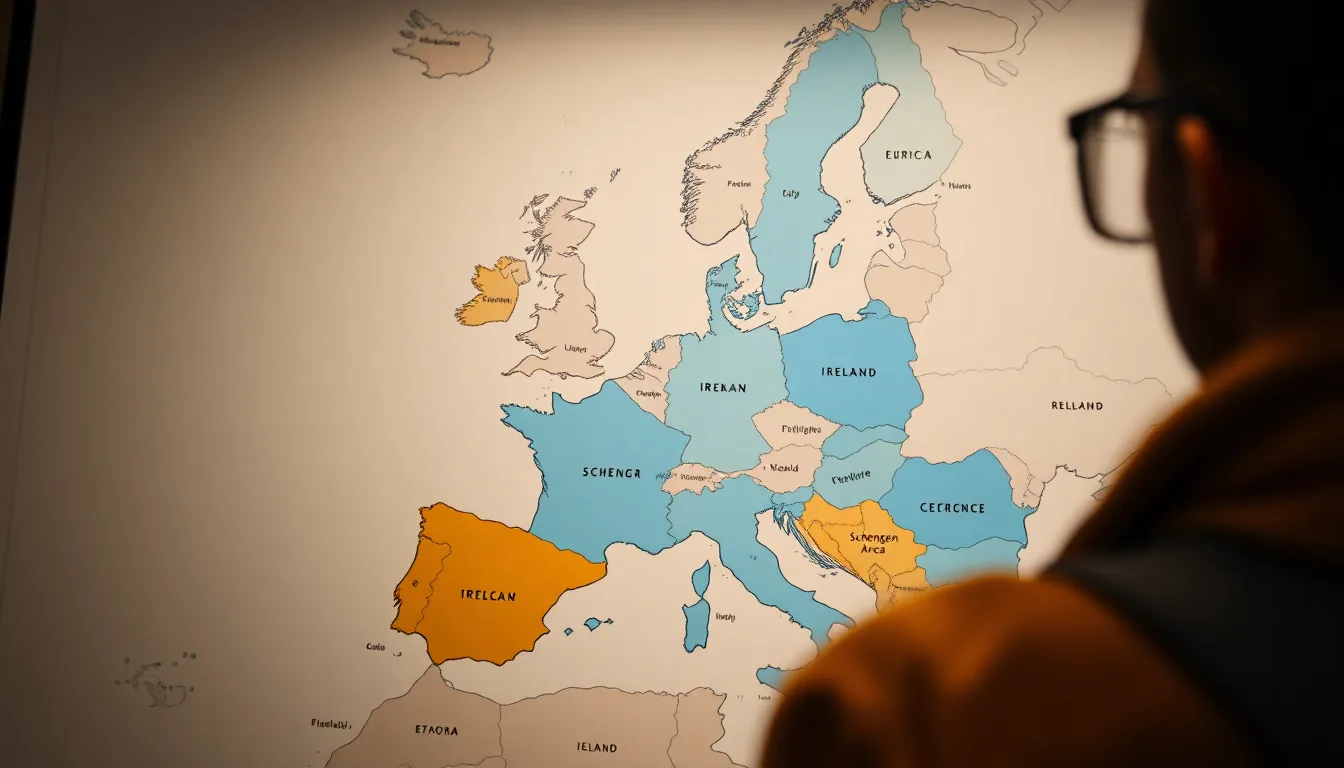
- Ireland requires its own separate visa for nationalities that need one — a Schengen visa alone does not grant entry.
- Days spent in Ireland are completely separate from your Schengen 90/180-day count, in both directions.
- Ireland and the UK share the Common Travel Area, letting Irish and British citizens move between the two countries with minimal border formality — a different system entirely from Schengen.
This trips up a lot of travellers building a multi-country European itinerary, especially those combining a UK or Ireland leg with a tour of continental Europe. Assuming your Schengen visa (or visa-free status) covers Ireland too is one of the more common — and costly — planning mistakes, and it's an easy one to make since Ireland genuinely looks and feels like the rest of Western Europe on the ground. Here's exactly how Ireland fits into the European travel landscape, what it means for your visa planning, and how to avoid the itinerary mistakes that catch people out.
Why isn't Ireland in the Schengen area?
When the Schengen Agreement was being formed in the 1980s and 1990s, Ireland made a deliberate choice to stay out, primarily to preserve the Common Travel Area (CTA) it had long shared with the United Kingdom. The CTA, which dates back to 1922, allows Irish and British citizens to move freely between Ireland, the UK, and the Crown Dependencies without needing passports or visas, and predates the EU itself.
Joining Schengen would have required Ireland to implement full passport controls at its border with Northern Ireland (part of the UK), which would have directly undermined the open border the CTA was built around. Rather than choose between the two systems, Ireland opted out of Schengen entirely, keeping the CTA intact. The UK made the same choice for the same underlying reason, before it left the EU altogether.
This is worth understanding because it explains something that otherwise looks inconsistent: Ireland is unmistakably part of the EU — it uses the euro, participates fully in EU institutions, and its citizens have full EU freedom-of-movement rights, same as any other member state — but it sits outside the specific short-stay border-control system that Schengen represents. EU membership and Schengen membership are related but genuinely separate things, and Ireland is one of the clearest examples of why they shouldn't be treated as the same.
What this means for your visa
If you hold a Schengen visa, or you're travelling visa-free under a Schengen visa-exemption agreement, that status does not extend to Ireland. Concretely:
- If your nationality requires a visa to visit Ireland, you need a separate Irish visa application — a Schengen visa in your passport doesn't cover it, no matter how it looks to a first-time traveller comparing the two systems.
- If your nationality is visa-exempt for both Ireland and Schengen (many nationalities are visa-exempt for short stays in both), you don't need either visa — but you're still tracked separately for each: your 90 days in Schengen and your permitted stay in Ireland are two different clocks.
- Ireland has its own separate travel authorization system in development, sometimes referred to loosely alongside ETIAS conversations, but it is administered independently of the EU's ETIAS system that applies to Schengen.
- A multiple-entry Schengen visa does not give you multiple entries into Ireland — those are unrelated permissions issued by different authorities.
Always check Ireland's own visa policy for your specific nationality directly through the Irish Immigration Service Delivery (INIS) or the relevant Irish embassy, rather than assuming your Schengen visa status tells you anything meaningful about your separate Ireland requirements.
The Common Travel Area, briefly explained
The Common Travel Area is the arrangement that lets Irish and British citizens travel, live, and work freely between Ireland, the United Kingdom, the Isle of Man, and the Channel Islands, without needing a passport for travel between these areas (though airlines typically still require photo ID) and without immigration checks in the way you'd expect crossing an international border.
For non-Irish, non-British travellers, the CTA works a little differently. If you enter the Common Travel Area through one country — say, you fly into the UK first — and then travel onward to Ireland, you may still be subject to immigration checks depending on your nationality and visa status, since the CTA's open-border spirit applies most directly to Irish and British citizens themselves. Non-CTA nationals should check both the UK's and Ireland's specific entry requirements rather than assuming free movement extends automatically to them.
Planning a mixed UK, Ireland, and Schengen itinerary
This is where most of the practical confusion happens. A common itinerary might look like: fly into Dublin, spend a few days in Ireland, take a short flight or ferry to the UK, then continue to continental Europe for a Schengen-area tour. Here's what actually applies at each stage:
- Entering Ireland: check Ireland's own visa or visa-exemption rules for your nationality — completely independent from Schengen.
- Moving between Ireland and the UK: generally straightforward for most travellers given the CTA, though again, check your specific nationality's requirements since the CTA's frictionless movement applies most fully to Irish and British citizens.
- Entering the Schengen area from the UK or Ireland: this is treated as a fresh Schengen entry. If you need a Schengen visa, it must already be arranged before this leg — you can't pick one up along the way. If you're visa-exempt for Schengen, your 90/180-day count starts (or continues) from this point.
The mistake to avoid: assuming that because Ireland, the UK, and the Schengen area all sit within "Europe" loosely speaking, one set of paperwork covers the whole trip. It doesn't. Treat each leg as its own entry requiring its own check.
Real-world scenarios that show why this matters
A few concrete examples make the practical stakes clearer than the rules alone:
- Scenario one: a traveller from a country that needs a Schengen visa books a trip covering Paris, then Dublin, then Rome. They apply for and receive a Schengen visa, assuming it covers the whole trip. It doesn't — without a separate Irish visa (if their nationality requires one), they'd be denied boarding or entry for the Dublin leg, even with a valid Schengen visa already in their passport.
- Scenario two: a visa-exempt traveller spends 60 days in the Schengen area, then flies to Ireland for two weeks, then returns to the Schengen area. Because Ireland sits outside the 90/180 count entirely, their Schengen clock effectively pauses during the Ireland leg — they still have 30 Schengen days left when they return, not a reduced allowance because of the time spent in Ireland.
- Scenario three: a traveller enters through Dublin planning to continue to continental Europe, assuming their Irish entry stamp (where applicable) also covers Schengen entry. It doesn't — the Schengen leg is treated as a completely fresh entry, with its own requirements checked independently at that border.
In each case, the underlying mistake is the same, repeated in three different forms: treating "Europe" as a single travel zone rather than several overlapping systems with genuinely different rules. Once you see Ireland and Schengen as fully separate systems, these scenarios stop being confusing and become simple to plan around.
How Irish authorities actually check your onward Schengen plans
If your itinerary includes Ireland followed by a Schengen destination, Irish immigration officers (for nationalities that go through checks) may ask about your onward travel plans as part of standard questioning, even though Ireland has no direct jurisdiction over your Schengen entry. This is fairly routine and not something to worry about — but it's worth being prepared to explain your full itinerary clearly and consistently at each border you cross, since inconsistent answers between the Ireland leg and the Schengen leg (different dates, different claimed purposes) can raise more questions than the actual facts would justify.
Keep your documentation for each leg readily accessible and organized separately — your Ireland-specific proof of accommodation and return travel in one place, your Schengen-specific documents in another — rather than one combined folder that makes officers dig through irrelevant paperwork to find what they're actually asking for. A little organization here saves real time at the counter.
Ireland compared to other non-Schengen EU members
Ireland isn't the only EU country outside Schengen, though the reasons differ. Cyprus is also an EU member state that hasn't joined the Schengen area, largely due to the island's ongoing political division — Cyprus is in the process of preparing for Schengen membership but hasn't completed it. Bulgaria and Romania, by contrast, joined the Schengen area for air and sea borders in 2024, with land border checks phasing out progressively — an example of a country moving into Schengen rather than staying out.
Ireland's situation is different from both of these — it's not a candidate working toward eventual membership, nor is it held up by unresolved political issues. It's a settled, long-term opt-out tied specifically to preserving the Common Travel Area with the UK, and there's no active process to change that.
Will Ireland ever join Schengen?
There's no active proposal or timeline for Ireland to join the Schengen area, and the underlying reason for staying out — protecting the open border with Northern Ireland under the Common Travel Area — has arguably become more politically significant since Brexit, not less. The Good Friday Agreement, which underpins peace in Northern Ireland, relies partly on there being no hard border infrastructure between Northern Ireland and the Republic. Introducing Schengen-style passport controls on that border would sit awkwardly against that arrangement, giving Ireland a strong, durable reason to maintain its current opt-out well into the future.
That's not a guarantee nothing will ever change — EU policy shifts over decades, not years — but travellers planning trips in the near term should treat Ireland's non-Schengen status as a stable, long-term fact rather than something that might resolve itself before their next visit, and plan their documentation accordingly rather than waiting to see what happens.
What about non-EU countries that use the Schengen system?
On the flip side, it's worth knowing that some Schengen area members aren't in the EU at all — Norway, Iceland, Switzerland, and Liechtenstein all participate fully in Schengen without being EU members, through separate association agreements. This is essentially the mirror image of Ireland's situation: those countries chose Schengen membership without EU membership, while Ireland chose EU membership without Schengen membership. Together, these examples make the point clearly — EU membership and Schengen membership are two entirely separate systems that happen to overlap for most, but not all, European countries.
Travellers building an itinerary around Norway or Switzerland, for instance, need to remember these countries follow Schengen's 90/180-day short-stay rules just like any EU Schengen member, even though neither is an EU country — the opposite confusion from Ireland's, but stemming from the same root misunderstanding that "EU" and "Schengen" are interchangeable labels.
How Brexit changed (and didn't change) this picture
Brexit prompted a lot of confusion about whether the Common Travel Area would survive the UK's departure from the EU, since the CTA had operated for decades within a context where both countries were EU members. In practice, both the UK and Irish governments explicitly reaffirmed the CTA as part of the Brexit withdrawal arrangements, and it remains fully in effect today, unaffected by the UK's EU exit.
What Brexit did change is the broader travel landscape around the CTA. The UK is now firmly outside both the EU and Schengen, meaning UK citizens travelling to the Schengen area follow the same visa-exempt short-stay rules (and, soon, ETIAS) as other non-EU visa-exempt nationalities. This is separate from the CTA question, but it often gets tangled up in the same conversation, since travellers reasonably associate "the UK leaving the EU" with broader questions about how easy movement around the British Isles and Europe still is.
The short version: CTA unaffected, but UK-to-Schengen travel now follows non-EU rules.
Working or studying: a different question from short-stay visits
Everything above focuses on short-stay tourism and business travel — the kind of trip a Schengen visa or visa-exemption typically covers. If your plans involve working or studying in Ireland, that's a fundamentally different category, requiring an Irish employment permit or student visa/study permit as appropriate, applied for directly through Irish authorities. The same logic applies on the Schengen side: a Schengen visa or visa-exempt status only covers short stays, not employment or long-term study, in any Schengen country either.
This distinction matters because "visa-free" or "visa-exempt" status, wherever it applies, is specifically a short-stay concept. Neither Ireland's system nor the Schengen system extends that visa-free courtesy to longer-term work or study arrangements — those always require their own dedicated application, regardless of how straightforward your short-stay entry might be.
Northern Ireland adds another layer worth understanding
Northern Ireland is part of the United Kingdom, not the Republic of Ireland, which means it sits inside the UK's immigration system rather than the Republic's. Because the Common Travel Area covers the whole of the UK and Ireland together, the practical experience of crossing the Northern Ireland–Republic of Ireland border is generally seamless for most travellers — there's no fixed passport control point on that land border, reflecting both the CTA and the political sensitivities tied to the Good Friday Agreement.
For travellers planning an itinerary that includes both Northern Ireland and the Republic of Ireland, it's worth knowing that you're technically moving between two different jurisdictions (UK and Ireland) even though the crossing itself feels informal. Your visa status for the UK and your visa status for Ireland are still governed by two separate sets of rules, even on a trip where you might drive across that border without ever presenting a passport.
This matters most for travellers who need a visa for one jurisdiction but not the other. If your nationality requires a UK visa but not an Irish one (or vice versa), driving casually across the Northern Ireland border without checking both requirements in advance can put you on the wrong side of an immigration rule, even without a formal checkpoint to catch the mistake on the spot. Sort out both sides of that border before you travel, not after you've already crossed it.
A quick mental model that avoids the confusion
The simplest way to keep all of this straight: think of "Europe" as containing several overlapping but distinct systems rather than one unified travel zone. The EU is a political and economic union. Schengen is a separate short-stay border-control zone that most, but not all, EU members join, and that a few non-EU countries join too.
The Common Travel Area is a distinct bilateral arrangement between Ireland and the UK, unrelated to either the EU or Schengen. Ireland sits at an interesting intersection: fully in the EU, fully in the CTA, but outside Schengen entirely.
Once you separate these three systems mentally, itinerary planning becomes much easier — you check each leg of a trip against the specific system that actually governs it, rather than assuming "European travel" is one uniform set of rules everywhere you go. It's a small mental shift, but it's the single most useful thing to take away from this whole topic if you only remember one thing, and it will save you from most of the planning mistakes covered above.
Practical documents to bring for an Ireland leg
If your itinerary includes Ireland, treat that leg's documentation as its own separate checklist:
- Check Ireland's specific visa requirement for your nationality on the official Irish Immigration Service Delivery website — don't infer it from your Schengen status.
- If a visa is required, apply through the Irish embassy or consulate for your country, following Ireland's own application process and timeline, separate from any Schengen visa application.
- Bring proof of onward travel and accommodation for the Ireland leg specifically, just as you would for the Schengen leg.
- If you're visa-exempt for Ireland, confirm the permitted stay length for your nationality, since it may differ from the 90-day Schengen allowance.
- Keep a printed or digital copy of your full itinerary showing all legs of your trip, so you can explain the sequence clearly if an Irish or Schengen border officer asks about onward or prior travel.
- If you're transiting through Ireland only, without leaving the airport, check whether your specific airport and airline require you to clear immigration anyway — some routings do, even for short connections.
Key takeaways
- Ireland is an EU member but not a Schengen member — it opted out to preserve the Common Travel Area with the UK.
- A Schengen visa does not cover entry into Ireland, and Ireland requires its own separate visa where applicable.
- Time spent in Ireland is entirely separate from your Schengen 90/180-day count, in both directions.
- Non-Irish, non-British travellers should check both the UK's and Ireland's specific requirements rather than assuming the Common Travel Area's frictionless movement applies to them automatically.
- On a mixed itinerary covering the UK, Ireland, and continental Europe, treat each leg's entry requirements separately rather than assuming one visa covers the whole trip.
This article provides general guidance, not official advice — always verify current entry requirements with the official website of the Irish Immigration Service Delivery or the relevant embassy before your trip.
Frequently asked questions
Quick answers on Ireland's status relative to Schengen, covering the questions that come up most often when travellers are planning a mixed itinerary across the British Isles and continental Europe.
Official sources
Check the authority for current fees and requirements before applying.
Frequently asked questions
Does a Schengen visa let me enter Ireland?
Does time spent in Ireland count toward my Schengen 90/180-day limit?
Why did Ireland not join the Schengen area if it is an EU member?
Can I travel between Ireland and the UK without a passport?
Are there other EU countries that are not part of the Schengen area?
This article is for general informational purposes only. Visa and travel authorisation rules change frequently. Always check the official government website before travelling.

Written & reviewed by
Can OTUTravel Authorisation Editor
Can OTU is the editor of ETA Travel Assistant, specialising in UK ETA, Schengen ETIAS, NZeTA and ESTA travel authorisations. Can monitors official government sources and policy updates to ensure every guide is accurate, current and genuinely useful for travellers.
View all guides →