How to Handle Uk Eta Application Form
- Apply at least 3 working days before you travel. Decisions usually come back much faster, but don't gamble on it.
- Every traveller needs their own ETA, including babies and children. The fee is non-refundable.
- Only use the official UK ETA app or gov.uk. Anything else is a third-party site charging you over the odds.
Filling in the UK ETA application form takes most people about ten minutes. The questions are short, there's no appointment, no documents to post, and no interview. Most applications come back approved the same day.
But there are a handful of fields where one small slip means paying £16 again and starting from scratch. Names in the wrong order. A passport that's about to expire.
A photo with a shadow across your face. All fixable — if you know before you start.
This guide walks through the form screen by screen. What it asks, what trips people up, and what happens after you hit submit. It's general guidance, not immigration advice, and UK rules do change — so check the official pages at gov.uk before you travel.
What the UK ETA actually is (and what it isn't)
The ETA stands for Electronic Travel Authorisation. It's a digital permission to travel to the UK, not a visa. It's also not a guarantee you'll be let in — a Border Force officer still decides that when you arrive.
Once approved, your ETA is linked electronically to the passport you applied with. There's no certificate, no sticker, no stamp. Nothing to print and nothing to show at check-in beyond your passport.
Here's what the £16 buys you:
- Two years of validity — or until your passport expires, whichever comes first.
- Multiple entries during that period. It isn't a one-trip ticket.
- Stays of up to 6 months at a time, for tourism, business, study or transit through the UK.
The scheme rolled out in stages. Qatar was first, in November 2023. Bahrain, Jordan, Kuwait, Oman, Saudi Arabia and the UAE followed in February 2024.
From 8 January 2025 it applied to all remaining visa-exempt nationals, and from 2 April 2025 it extended to EU and EEA citizens too. In practice, that means almost everyone who previously travelled to the UK without a visa now needs one.
Irish citizens are the big exception. They don't need an ETA, ever.
Who has to fill in the UK ETA application form?
You need an ETA if you're a visa-exempt national and you don't already hold UK immigration permission. That covers most travellers from the US, Canada, Australia, New Zealand, Japan, South Korea, Singapore, the Gulf states and the EU.
You do not need one if any of these apply to you:
- You're a British or Irish citizen.
- You hold a valid UK visa (visitor, student, work, family — any route).
- You have permission to live, work or study in the UK, including settled or pre-settled status.
- You're a visa national — you need a visa instead, and an ETA won't replace it.
Not sure which side of the line you fall on? Work through our guide to who needs a uk eta before you spend money on an application you don't need.
The dual-national trap
This one catches people every week. If you hold British citizenship — even if you also hold a US, Australian or South African passport — you are not eligible for an ETA. British citizens don't get travel authorisations for their own country.
The decision rule is simple: if you're a British citizen, travel on your British passport. If you don't have one, apply for one, or look into a Certificate of Entitlement to the right of abode. Don't apply for an ETA — it'll be refused or cancelled, and you'll lose the fee.
Before you start: five things to have in front of you
You can't save a half-finished ETA application and come back to it. Once you start, you need to finish. So gather everything first.
- Your passport. The one you'll actually travel on. Not an old one, not a second passport you might use instead.
- A smartphone if you're using the app — the UK ETA app works on modern iPhones and Android devices and needs a working camera.
- A debit or credit card for the fee. The official service accepts major cards; the app also supports mobile wallets on most devices.
- An email address you can access while travelling. Your decision arrives by email.
- A well-lit spot for the photo. A plain wall behind you and no strong light behind your head.
That last point matters more than it sounds. The photo is the single most common reason an application gets bounced back or takes longer than it should.
There's a fuller checklist on our uk eta application requirements page if you want to double-check before you begin.
How to fill in the UK ETA application form: step by step
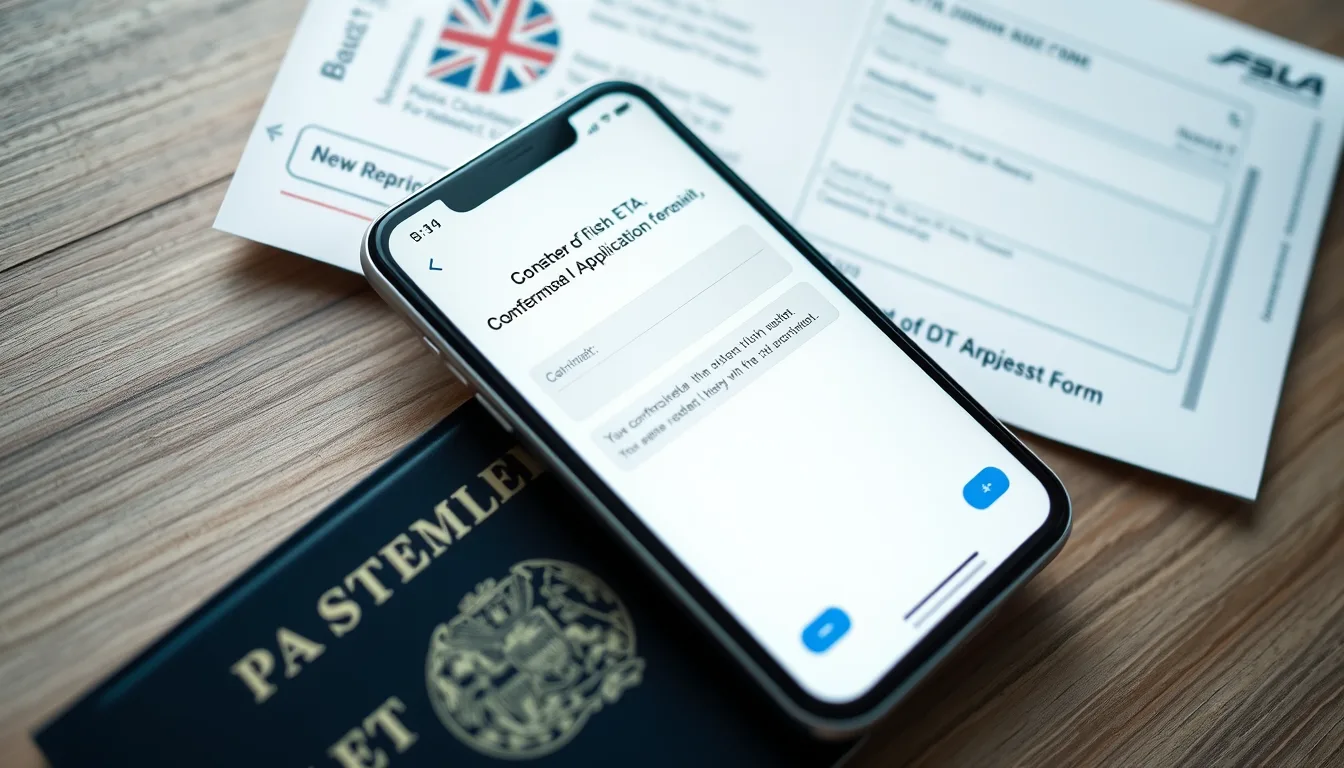
There are two official routes: the UK ETA app, or the online form at gov.uk. They ask for the same information. The app is faster because it reads your passport chip and takes the photo for you.
Here's the sequence, in the order you'll meet it.
Step 1 — Choose the official route, and only the official route
Download the UK ETA app from the Apple App Store or Google Play, or go directly to the gov.uk page. That's it. Those are the only two official ways to apply.
Search results are full of lookalike sites with names like uk-eta-apply or eta-uk-visa. They'll happily take your money — often £50 to £100 — for a form you could have filled in yourself for £16. Some simply forward your details to the real service and pocket the difference.
Step 2 — Scan your passport (or type the details in)
On the app, you hold your phone over the photo page. It reads the machine-readable zone — the two lines of chevrons at the bottom — and pulls your name, passport number, dates and nationality automatically.
If your phone can't read the chip or the scan fails, you can enter the details manually. There's no penalty for doing it by hand. Just be slow and accurate.
Double-check the passport number character by character. The number 0 and the letter O look almost identical on a worn passport, and this is where most typing errors happen.
Step 3 — Take or upload your photo
The app takes a live photo of your face. On the website, you upload a digital photo file instead.
What the photo needs to show:
- Your full face, looking straight at the camera, eyes open, mouth closed.
- No glasses, no hat, no headphones. Nothing covering your face.
- A plain, light background with no shadows behind you.
- Neutral expression — no big smile.
It's the same standard as a passport photo, but you don't need a professional studio. A phone photo against a white wall in daylight works fine.
Step 4 — Confirm your personal details
This is where you check what the scan pulled through: given names, surname, date of birth, place of birth, nationality and sex as shown on your passport.
The names are the tricky bit. If your passport shows a middle name, include it. If your passport shows your name in a different order to what you're used to — family name first, for example — copy the passport exactly.
Your ETA must match your passport. If it doesn't, an airline check-in agent may spot the mismatch and refuse to board you. That's a genuinely miserable way to start a holiday.
Step 5 — Add your contact details
You'll enter an email address and usually a phone number. Use an address you'll still be able to open in two years' time, because that's how long the ETA lasts.
Don't use a work email that expires when your contract does. Don't use a temporary or throwaway address. And add the sender to your safe list — decision emails sometimes land in spam.
Step 6 — Answer the employment and background questions
The form asks about your job — occupation, and in some cases employer details. If you're retired, a student or between jobs, there are options for that. Don't leave it blank.
Then come the suitability questions. These are the ones that make people pause: criminal convictions, previous immigration problems, refusals, removals. Answer truthfully.
The Home Office already has access to a lot of this data, and a false answer is far worse than an honest one.
You don't need to describe spent convictions that are legally filtered under UK rules, but if you're unsure how your history should be declared, get proper immigration advice rather than guessing.
Step 7 — Review every field against your passport
You'll get a summary screen before you pay. Read it properly. Not a glance — an actual check, line by line, with the passport open next to you.
Check the passport number, the expiry date, the spelling of every name, and your date of birth. Mistakes here are the ones that cost you a second fee.
Step 8 — Pay the fee
The fee is £16 per person. It went up from £10 on 9 April 2025, so any guide quoting £10 is out of date.
There are no refunds. Not if you change your mind, not if your plans change, not if your application is refused. There's more on the numbers in our breakdown of how much does a uk eta cost.
Step 9 — Wait for the decision
You'll get a confirmation screen with a reference number, then an email. Most decisions arrive within hours — sometimes minutes. The official guidance is that it can take up to 3 working days, which is why you should apply at least 3 working days before you travel.
Occasionally the Home Office asks for more information. If that happens, respond quickly and don't book anything non-refundable until you have the approval.
Step 10 — Save your reference number
Screenshot the confirmation and email the screenshot to yourself. You almost certainly won't need it — your ETA is linked to your passport electronically — but if something goes wrong at the airport, having the reference number makes the conversation far easier.
UK ETA at a glance: the numbers that matter
Here's the reference table. Figures are correct as of the time of writing, but always confirm on gov.uk before you apply.
| Detail | What it is | Notes |
|---|---|---|
| Fee | £16 per person | Rose from £10 on 9 April 2025. Non-refundable. |
| Validity | 2 years, or until your passport expires | Whichever is sooner. |
| Entries | Multiple | No limit on trips during the validity period. |
| Maximum stay | 6 months per visit | Tourism, business, study, transit. |
| Where to apply | UK ETA app or gov.uk | No other route is official. |
| Processing | Usually hours; official guidance says allow 3 working days | Apply before you travel, not at the airport. |
| Children | Need their own ETA at full fee | Includes babies and infants. |
| Irish citizens | Not required | Exempt entirely. |
| British citizens | Not eligible | Travel on a British passport instead. |
The four fields that trip people up most
After the fee, almost every problem with the UK ETA application form comes down to one of four things.
1. The name field
Type your name exactly as it appears in the machine-readable zone of your passport. That means the same spelling, the same order, and no added middle names that aren't printed there.
If your passport has a hyphenated surname, keep the hyphen. If it has an accent, include it. Your ETA is matched against your passport by a computer, not a human.
2. The passport expiry date
This is the field people get wrong because they read the issue date instead. Look for the line marked expiry or date of expiry, and check the month and day order — UK passports show DD MMM YYYY, while US passports show MM/DD/YYYY.
3. The photo
Dark background, glasses, a shadow across one eye, someone else in the frame, a screenshot of an old photo — all of these cause problems. Take the photo fresh, in daylight, facing a window.
4. The travel-date question
Some versions of the form ask when you plan to arrive. It doesn't lock you in, but don't put a date in the past and don't put a date more than a year out if you want to avoid a query.
How long does the UK ETA application form take to fill in?
Realistically, ten to fifteen minutes from download to payment. The app is quicker than the website because the passport scan fills in most of the fields for you.
Add a few minutes if you're applying for several people in one sitting. There's no family application — you go through the whole process separately for each traveller, one at a time.
Then add the wait for a decision. Usually under an hour. Officially, up to 3 working days.
Applying for children and babies
Every traveller needs their own ETA, and that includes newborns. There's no family rate, no discount for children, and no exemption for infants travelling on a parent's lap.
The process is the same as for an adult, with a couple of practical tweaks:
- You apply on the child's behalf, using your own email address and phone number.
- The child needs their own passport with their own passport number.
- The photo still needs to show their full face. A sleeping baby with their head turned won't pass.
- For very young children, a photo taken lying down on a plain white sheet, shot from directly above, is often the easiest way to get a clean result.
The fee is the same £16 per child. A family of four pays £64.
Can someone else fill in the form for you?
Yes. You can complete the UK ETA application form on behalf of another adult, as long as you have their passport and their permission. Plenty of people do this for elderly parents or relatives who aren't comfortable with apps.
Two things to be careful about. First, use contact details that the applicant can actually access — not yours, unless you'll be travelling together and can forward the decision. Second, get the details right.
The applicant carries the consequences of any error, not you.
What you can't do is use an agent who submits through anything other than the official app or gov.uk. Paid help filling in the form is fine in principle, but there's no reason to pay for it.
What most guides get wrong about the UK ETA form
There's a lot of recycled misinformation out there. Here are the ones that come up again and again.
Wrong: you must apply 72 hours before travel
The official wording is that you should apply at least 3 working days before you travel. Working days exclude weekends and bank holidays. If you're flying on a Monday, applying on Friday afternoon is cutting it finer than it looks.
Wrong: you can apply at the airport
You can technically submit an application from anywhere, including the departure lounge. But if the decision doesn't come back before your flight, the airline won't board you. There is no expedited service and no walk-up counter.
Wrong: one ETA covers your family
It doesn't. Each traveller holds an individual authorisation linked to their own passport.
Wrong: the ETA is a visa
It isn't. An ETA gives you permission to travel to the UK and seek entry as a visitor. It doesn't grant you entry, doesn't let you work, and doesn't count towards settlement.
Wrong: you need to print it
You don't. Nothing is issued in paper form. Your authorisation lives on the Home Office system, tied to your passport number.
Wrong: a new passport carries the old ETA over
It doesn't. This is the misconception that costs the most money. Your ETA is tied to a specific passport number.
Renew the passport and the ETA becomes useless — you apply again and pay again.
A decision rule worth remembering on passport renewal
Here's the rule, stated plainly: if your passport has less than two years left on it, sort the passport first, then apply for the ETA.
Do it the other way round and you'll pay £16 for an ETA that dies with your old passport. If you travel regularly, that could mean applying twice in a single year.
It's a small piece of sequencing that saves real money. Check your passport expiry date before you open the app, not after.
What happens after you submit: three possible outcomes
You'll get one of three responses.
- Approved. The most common outcome by a wide margin. You'll get an email confirming your ETA and its expiry date. Nothing else to do.
- Further information requested. The Home Office may email asking for more detail or documents. Respond promptly and completely. Don't travel until it's resolved.
- Refused. You'll be told why, in general terms, and the fee is not returned. You can't appeal an ETA refusal, but you can apply for a visa instead — and for most people that's the right next step, not a fresh ETA application.
One important point: an ETA refusal doesn't automatically ban you from the UK. It means you can't travel on the ETA route. A visa application lets a caseworker look at your circumstances properly.
A worked example: what this looks like in practice
Here's a realistic scenario, drawn from how these applications typically play out. Names changed.
Marco and Elena are Italian nationals living in Milan. In early April 2025 they booked a long weekend in London for the end of the month — four travellers: themselves, their 14-year-old son and their 2-year-old daughter.
What they did right: they started applications nine days before departure, not two. Marco downloaded the UK ETA app and ran all four applications in one evening.
Where it went sideways: Marco's own passport had 14 months left on it. He applied anyway, got his ETA approved in under an hour, then realised the authorisation would expire with the passport — long before the two-year mark. He renewed his passport in the summer and had to apply again.
Total cost for him: £32 instead of £16.
The toddler's application was the second snag. Elena's first photo attempt showed the child asleep and turned slightly away. It was rejected in the app before submission, so it cost nothing but time — but it added a day to the process while they waited for decent daylight.
The final tally: four ETAs at £16 each = £64. Decisions for three of them came back within an hour. The fourth took until the next morning.
Nothing was printed, nothing was shown at check-in beyond passports, and all four sailed through the ePassport gates at Heathrow.
Total time invested: about 40 minutes across two evenings. Total money spent on third-party sites: zero.
Common mistakes and how to fix them
| Mistake | What happens | The fix |
|---|---|---|
| Wrong name order | Possible boarding refusal at check-in | Apply again with the exact passport spelling. The fee isn't refunded. |
| Old passport number used | ETA won't match your travel document | New application with the current passport. |
| Bad photo | App usually rejects it before submission | Retake in daylight against a plain wall. |
| Applied too late | Airline may refuse boarding | Nothing to do but rebook. Apply 3+ working days ahead next time. |
| Used a third-party site | You paid £50–£100 for a £16 form | Nothing recoverable. Use the app or gov.uk next time. |
| Escaped the request for information | Application sits unresolved | Reply to the email with the documents requested. |
UK ETA, visa or ETIAS — which one do you need?
These three get mixed up constantly.
- UK ETA — for visa-exempt nationals travelling to the UK. £16, two years, applied for online.
- UK visa — for visa nationals, or for anyone coming to work, study long-term, join family or settle. Applied for through the Home Office, with biometrics and a much longer process.
- ETIAS — the EU's equivalent scheme, separate from the UK. It applies to Schengen travel, not to Britain, and it's a completely different application. Holding one doesn't help with the other.
If you're flying to the UK and then on to Europe, you may need both. Check each scheme separately, on the relevant official site.
Transiting through the UK? Read this bit
Plenty of travellers assume that staying airside at Heathrow means they don't need any UK authorisation. In most cases that's wrong.
The ETA requirement generally applies to transit through the UK, including airside transit where you don't pass through border control. If you're changing planes at a UK airport, budget for an ETA as part of your trip planning.
There are narrow exemptions, and they depend on your nationality, your route and where you're travelling from. Don't assume you qualify. Check the exemption list on gov.uk, or ask the airline, before you book a non-refundable connection.
How to spot an ETA scam site
Fake ETA sites are one of the more profitable travel scams going. They look professional, they rank well, and they charge four to six times the real fee.
Tell-tale signs:
- The URL isn't gov.uk and the app isn't published by the UK Home Office.
- They promise faster processing, guaranteed approval or priority handling. None of that exists.
- They ask for additional documents like bank statements or hotel bookings.
- They charge a service fee on top of the government fee, often buried at the payment screen.
If you've already paid one, contact your card provider quickly. And if you handed over passport details, keep an eye out for identity fraud.
At the border: what the ETA does and doesn't do
Your ETA gets you to the UK. It doesn't get you in.
When you arrive, a Border Force officer can still ask questions, ask to see onward travel or accommodation details, and refuse entry if something doesn't add up. Having an approved ETA doesn't override any of that.
A few practical points:
- Travel on the passport you applied with. A different passport means no valid ETA.
- Be ready to explain your visit simply and honestly — purpose, length of stay, where you're staying.
- You can't work in the UK on an ETA. Business meetings, conferences and incidental remote work are generally fine, but taking a paid job is not.
- Visa-free entry is a privilege, not a right. Being turned away is rare, but it happens — and having your paperwork straight is the best protection.
Do you need to apply again after a refusal or a visa?
If you're later granted a UK visa, you don't need an ETA for those trips — the visa covers you. The same goes if you're granted permission to live, work or study in the UK.
But if that permission ends and you later travel as a visitor, you'll need an ETA again at that point. It doesn't renew itself and there's no automatic reinstatement.
And if your ETA was refused, applying again with identical information almost never helps. The right move is a visa application, where you get to explain your circumstances to a person.
Should you apply early, or is there no point?
There's no benefit to applying six months ahead, because the two-year clock starts when the ETA is granted. If you apply in January for a trip in December, you've burned almost a year of validity.
The sweet spot is simple:
- Book your trip first.
- Check your passport has at least six months left, and ideally more than two years.
- Apply 1–3 weeks before departure. Early enough to handle any delay, late enough to maximise your two years.
- Don't wait until the day before. That's where the horror stories come from.
Key takeaways
- The UK ETA application form takes about 10 minutes and costs £16 per person, including children and babies.
- Apply only through the official UK ETA app or gov.uk. Third-party sites charge several times the real fee and offer nothing extra.
- Submit at least 3 working days before travel. Most decisions come back within hours, but don't rely on it.
- Your ETA lasts two years or until your passport expires — so if your passport is close to renewal, renew it first and save yourself a second £16.
- Copy your name and passport number exactly as they appear in your passport. Mismatches cause real problems at check-in.
- Every traveller needs their own ETA. There's no family application and no group discount.
- If you're a British citizen, you're not eligible for an ETA — and if you hold a UK visa or settled status, you don't need one.
- The ETA is permission to travel, not permission to enter. Border Force still makes the final call.
- Requirements, fees and processing times do change. Verify everything with official sources before you travel.
Frequently asked questions
Can I apply for a UK ETA at the airport on the day I fly?
Does my baby or toddler need their own UK ETA?
What should I do if I made a mistake on my UK ETA application form?
How much does the UK ETA application form cost, and is it refundable?
My UK ETA hasn't been approved within 3 working days — what now?
This article is for general informational purposes only. Visa and travel authorisation rules change frequently. Always check the official government website before travelling.

Written & reviewed by
Can OTUTravel Authorisation Editor
Can OTU is the editor of ETA Travel Assistant, specialising in UK ETA, Schengen ETIAS, NZeTA and ESTA travel authorisations. Can monitors official government sources and policy updates to ensure every guide is accurate, current and genuinely useful for travellers.
View all guides →