New Zealand Electronic Travel Authority (NZeTA): Complete Guide
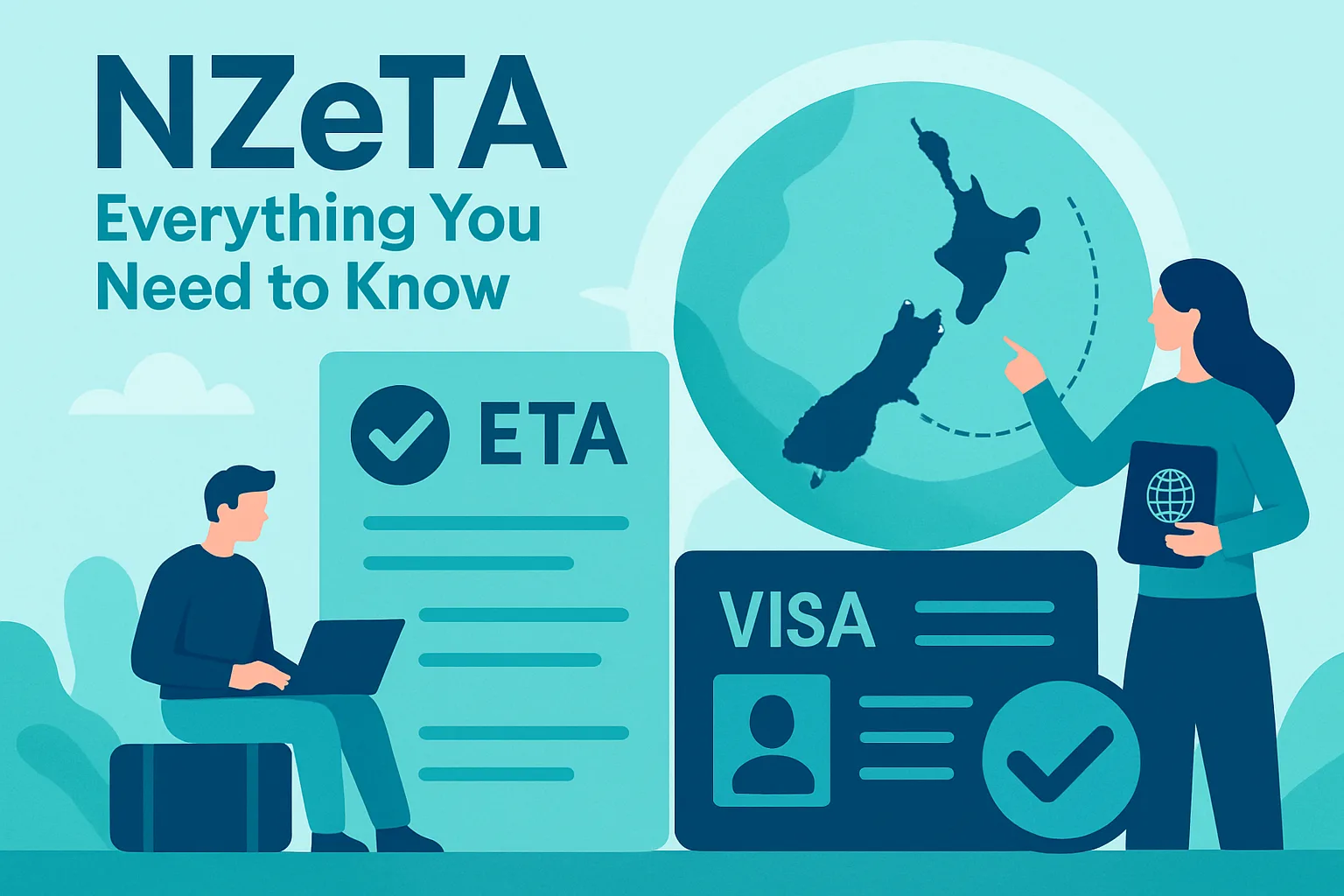
- NZeTA is required for most visa-waiver visitors entering New Zealand for short stays — tourism, business, transit, or family visits.
- It's applied for online through the official New Zealand immigration website or app, with most decisions arriving within minutes to a few hours.
- An approved NZeTA is valid for up to two years, covering multiple visits within that window, each subject to standard duration limits.
Here's everything you need to know to get started with your NZeTA application, with pointers to more detailed guides on specific topics.
What NZeTA actually is
NZeTA is an electronic travel authorisation, linked digitally to your passport, required for eligible visa-waiver visitors before travelling to New Zealand. It's not a visa in the traditional sense — it's a lighter-weight, largely automated pre-screening process, confirming basic eligibility before you travel rather than requiring the more detailed application a full visa involves.
Who needs an NZeTA
Visa-waiver travellers from eligible nationalities need an NZeTA for short-stay visits to New Zealand, covering tourism, standard business activities, family visits, and transit. Nationalities outside New Zealand's visa-waiver arrangement need a full Visitor Visa instead, regardless of trip length or purpose. Since eligibility spans a broad but genuinely varied range of countries, always check your own specific nationality's current status directly against the official source rather than assuming based on general region.
How to apply for an NZeTA, step by step
- Go to the official New Zealand immigration website or download the official app — never a third-party site.
- Enter or scan your passport details accurately.
- Upload or take a suitable photo, following the official requirements.
- Answer health, character, and background questions honestly and completely.
- Pay the combined NZeTA fee and IVL levy.
- Wait for your decision, checking your email and the official status checker.
What NZeTA costs

The combined cost includes the NZeTA application fee itself and the separate International Visitor Conservation and Tourism Levy (IVL), which funds conservation and tourism infrastructure projects. Some nationalities, notably Australian citizens, are exempt from the IVL specifically. Always check the current combined figure directly on the official website, and apply only through official channels — unofficial third-party sites frequently charge considerably more for identical processing.
How long NZeTA processing takes
Most applications are approved automatically within minutes to a few hours. A smaller share take longer, generally tracing back to identifiable causes like data verification, background review, or higher application volume during peak periods, rather than being random. Apply several days before travel to comfortably absorb this variation.
How long an approved NZeTA remains valid
Once approved, NZeTA is valid for up to two years, or until your passport expires, whichever comes first, covering multiple visits within that window, each subject to the standard visa-waiver stay duration. This means travellers making more than one New Zealand trip within this period generally don't need to reapply for each individual visit, provided their passport details remain unchanged.
NZeTA versus a Visitor Visa
Whether you need NZeTA or a full Visitor Visa depends on three factors: your nationality's eligibility, whether your stay fits the standard duration limit, and whether your purpose fits standard visa-waiver activities. If any of these three conditions doesn't apply to your situation, a Visitor Visa is required instead, involving a more detailed application and considerably longer processing time.
Transiting through New Zealand
Whether you need NZeTA for a New Zealand transit depends on your specific airport, airline, and booking type — through-checked connections at Auckland, New Zealand's primary hub, may stay within a transit area, while other connections require clearing border control, meaning a valid NZeTA is needed if you're eligible. If you're leaving the airport during a longer layover, you're entering New Zealand rather than transiting, and standard NZeTA requirements apply.
Applying for children
Every child, including infants, needs their own individual NZeTA linked to their own passport — there's no exemption based on age, and no way to add a child to a parent's application. A parent or guardian completes the application on the child's behalf, with the photo requirement often being the most practically challenging part, particularly for infants.
Multiple visits and cumulative travel patterns
The standard duration limit applies per individual visit, but immigration authorities can still consider your overall pattern of visits, particularly if they're frequent and closely spaced. A pattern of genuine, well-spaced, clearly distinct visits raises no concern, while a pattern resembling continuous presence through repeated short visits can draw closer scrutiny even when each individual visit technically complies with the standard limit.
What happens if your application is refused
A refusal is uncommon but can happen, generally tracing back to a data mismatch, an incomplete application, or a specific background concern. Reviewing the specific reason given, correcting any identifiable data issue, and reapplying resolves most straightforward cases. For refusals linked to genuine background or eligibility concerns, a standard Visitor Visa, allowing individual review, may be the more appropriate route.
Common mistakes that lead to avoidable rejections or delays
- Applying through an unofficial, marked-up third-party website instead of the official channel.
- Submitting a photo that doesn't meet official requirements.
- Entering passport details that don't precisely match your actual document.
- Applying too close to your travel date, leaving no buffer for a longer-than-typical processing time.
What to do if your NZeTA is taking longer than expected
If your application is taking noticeably longer than the typical range, check your payment processed successfully, review your submitted details against your passport, and consider whether you're applying during a known busier period. If none of this explains the delay and your travel date is approaching, contact official support directly with your application reference number.
What NZeTA doesn't cover
NZeTA doesn't cover taking up employment with a New Zealand employer, enrolling in a full academic program, or settling in New Zealand long-term. It's specifically designed for genuine, temporary visitor activity — tourism, standard business visits, family visits, and transit — within the standard duration limit.
A brief history of NZeTA
NZeTA was introduced as part of New Zealand's broader shift toward pre-screening visa-waiver visitors before arrival, a model already used by other countries for years, most notably the United States with its ESTA system. Rather than relying solely on checks conducted at the point of arrival, this approach allows New Zealand immigration authorities to identify potential concerns before a traveller's journey even begins, while also collecting the IVL levy that funds conservation and tourism infrastructure projects across the country.
What information the application actually asks for
Beyond your basic passport details and a photo, the NZeTA application includes health and character declaration questions, covering things like relevant medical history and any criminal convictions. These questions exist to support New Zealand's standard visitor screening process, and answering them honestly and completely, rather than glossing over anything uncertain, is essential — inconsistent or incomplete answers are a common source of avoidable delay or review.
How the application photo requirements work
Your NZeTA photo needs to meet specific technical requirements — a neutral expression, even lighting, a plain background, and open eyes clearly visible. Taking your photo carefully, ideally with natural light against a plain wall, and reviewing it critically before uploading, helps avoid the kind of photo-related delay that affects a meaningful share of otherwise straightforward applications, particularly for children, where a separate dedicated guide covers the specific challenges in more depth.
Understanding the IVL levy specifically
The International Visitor Conservation and Tourism Levy is collected alongside the NZeTA fee for most applicants, funding conservation projects — national parks, walking tracks — and broader tourism infrastructure. Australian citizens and certain other specific categories are exempt from this levy specifically, reflecting New Zealand's particular bilateral relationships. A dedicated guide covers the full detail of who qualifies for this exemption and exactly where the revenue goes.
Avoiding overpayment through unofficial websites
A meaningful share of NZeTA applicants unknowingly pay considerably more than the official rate by applying through unofficial third-party websites that charge a significant markup for identical processing. Always apply through the official New Zealand immigration website or app directly, checking the URL carefully before entering any payment details, and treating a noticeably higher price than the known official rate as a clear warning sign.
What business travellers specifically should know
NZeTA covers standard business activities — meetings, conferences, negotiations — provided you're not taking up actual paid employment with a New Zealand-based entity or performing hands-on local work. If your business trip involves genuine local implementation work rather than standard visitor-level business activity, a different visa category may be more appropriate, and it's worth reviewing your specific planned activities carefully against this distinction before assuming NZeTA automatically covers your trip.
What tourists specifically should know
For straightforward tourism trips within the standard duration limit, NZeTA is specifically designed to be the simple, fast route into New Zealand, without the more detailed documentation and individual review a Visitor Visa involves. Most tourists experience nothing more than a quick, automated approval, provided their application is completed carefully and their nationality and trip details clearly fit standard visa-waiver terms.
How family and group applications work in practice
Since every traveller needs their own individual NZeTA, families and groups apply for each member separately, ideally completing one person's application fully before starting the next to avoid mixing up details between travellers. There's no combined family discount or bundled application — each person's NZeTA is entirely independent, though applying for the whole family in one focused sitting keeps the process organised and easier to track.
Key takeaways
- NZeTA is required for most visa-waiver visitors to New Zealand, applied for online, with most decisions arriving within minutes.
- Eligibility depends on your nationality, and the combined fee includes the IVL levy, with some exemptions like Australian citizens.
- An approved NZeTA is valid for up to two years, covering multiple standard-length visits within that window.
- For deeper detail on any specific topic — cost, transit, children, processing delays — dedicated guides cover each in considerably more depth.
This article provides general guidance, not official advice — always verify current requirements and fees directly on the official New Zealand immigration website before applying, since specific figures, eligibility lists, and process details are reviewed periodically and can change over time as the system continues to develop.
Why this guide serves as a genuine starting point
Given how many specific circumstances travellers bring to their own NZeTA application — different nationalities, family situations, business purposes, transit routes — no single guide can exhaustively cover every possible scenario in full depth. This guide is deliberately built to give you a genuinely solid, accurate foundation, with clear pointers toward more specialised, detailed guides covering the specific areas most likely to genuinely matter for your own particular trip and personal circumstances.
Where to go next for more detail
This guide is deliberately structured as a starting point, covering the essentials of NZeTA broadly rather than exhaustively. For deeper detail on any specific area — the exact IVL exemption rules, a full breakdown of hidden costs to avoid, transit specifics for particular New Zealand airports, or the complete children's application walkthrough — dedicated guides on each of these specific topics go into considerably more depth than is practical to cover fully here.
How to check your NZeTA status after applying
Once submitted, you'll typically receive an email confirmation once a decision is made, and you can also check your status directly through the official online checker using your passport details. It's worth confirming your status shows as genuinely approved, not just submitted or pending, particularly if you're travelling soon and want certainty before finalising other travel arrangements.
What to bring alongside your approved NZeTA when you travel
- Your physical passport, matching exactly the details used in your NZeTA application.
- A digital or printed copy of your NZeTA confirmation, easily accessible during travel.
- Evidence of your onward or return travel, since border officials may ask about your overall itinerary.
- Basic details of your accommodation and trip purpose, in case you're asked at the border.
What happens at the New Zealand border with an approved NZeTA
Your NZeTA is checked electronically, linked to your passport, meaning there's no physical stamp or document to present in the traditional sense. Border officials may still ask routine questions about your trip's purpose and duration, and having your confirmation and basic itinerary details accessible generally makes this a smooth, quick part of your arrival rather than a source of delay.
NZeTA and New Zealand's biosecurity requirements
Separate from NZeTA itself, New Zealand maintains strict biosecurity requirements given the country's unique, carefully protected natural environment. Arriving passengers complete a biosecurity declaration as part of the standard arrival process, and being prepared with accurate answers about any food, plant material, or outdoor equipment you're bringing helps this part of your arrival go smoothly alongside your already-confirmed NZeTA status.
How NZeTA compares to similar systems in other countries
NZeTA operates on a broadly similar principle to comparable systems elsewhere — the US ESTA, the UK ETA, and Europe's developing ETIAS system — each offering a fast, largely automated pre-travel authorisation for visa-waiver visitors rather than a full visa process. Each system remains entirely separate, with its own website, fee, and validity period, so holding one doesn't grant any entry rights to a different country, and travellers combining New Zealand with other destinations need to plan each country's specific requirements independently.
Extending your stay beyond the standard limit
If you're already in New Zealand and want to extend your stay genuinely beyond the standard visa-waiver duration limit, this typically requires transitioning to an appropriate visa category from within New Zealand, rather than simply continuing to rely on your original NZeTA once its standard terms no longer cover your extended plans. Address this proactively, well before your NZeTA-covered time expires, since overstaying can create serious complications for future New Zealand entry.
What students should know about NZeTA
NZeTA can cover short courses that don't amount to formal, full-time enrolment, similar to how this works under comparable systems elsewhere, but a full academic year or degree program requires a proper Student visa instead. If you're planning study in New Zealand, check your specific course's duration and enrolment status carefully before assuming NZeTA covers your situation.
What retirees and seasonal visitors should know
Retirees planning seasonal or recurring New Zealand visits should be mindful of the cumulative travel pattern considerations covered in more depth elsewhere — while each individual visit is assessed against the standard limit, immigration authorities can still look at your overall pattern of visits, particularly if they're frequent and closely spaced, when assessing whether your visits genuinely reflect standard visitor activity rather than something closer to ongoing residence.
How to build NZeTA into your regular trip-planning routine
Whether this is your first NZeTA application or you're a returning visitor, treating the application as a standard, routine part of planning any New Zealand trip — alongside flights, accommodation, and travel insurance — keeps this step from becoming a last-minute source of stress. Checking your existing NZeTA's validity before assuming you need to reapply, and applying with a comfortable buffer before travel, are the two habits that most reliably keep this process smooth on every future trip.
What to do if you're helping someone else apply
If you're assisting a family member, friend, or colleague with their own NZeTA application, the same underlying principles apply — use their own passport details and photo, answer their background questions accurately based on their own circumstances, and confirm you have appropriate authority to apply on their behalf, particularly for a child or someone unable to complete the application themselves. Taking the same careful, methodical approach recommended throughout this guide, regardless of whose application you're completing, gives the best chance of a smooth, first-time approval.
Dual nationals and multiple passports
If you hold more than one passport, decide before applying which specific document you'll actually travel on, and use that passport's details consistently throughout your NZeTA application. Your other nationality and passport are irrelevant to this specific trip's entry requirements, provided you travel consistently on whichever document you've applied under, avoiding any mixing of details between your different passports.
What happens if your passport is renewed after approval
Since your NZeTA is linked to a specific passport number, renewing your passport after approval breaks that link, even if your original NZeTA would otherwise still be within its two-year validity window. If you know a passport renewal is coming up before your next New Zealand trip, it's worth timing your NZeTA application for after the new passport arrives, so you only need to go through the process once.
A final summary before you apply
Bringing everything covered throughout this entire guide together in one place: confirm your specific nationality's current eligibility status, apply strictly through the official channel only, take a genuinely careful photo meeting every technical requirement, answer each question honestly and completely, pay the current combined fee accurately, and apply with a comfortable, sensible buffer well before travel. Following these straightforward steps carefully and consistently is genuinely sufficient for the overwhelming majority of travellers to secure a smooth, fast NZeTA approval, entirely without needing any paid third-party assistance whatsoever.
Frequently asked questions
Quick answers on the essentials of the New Zealand Electronic Travel Authority, covering eligibility, cost, and validity.
Official sources
Check the authority for current fees and requirements before applying.
Frequently asked questions
What is the New Zealand Electronic Travel Authority (NZeTA)?
How much does NZeTA cost?
How long does NZeTA take to process?
How long is an approved NZeTA valid?
Do children need their own NZeTA?
This article is for general informational purposes only. Visa and travel authorisation rules change frequently. Always check the official government website before travelling.

Written & reviewed by
Can OTUTravel Authorisation Editor
Can OTU is the editor of ETA Travel Assistant, specialising in UK ETA, Schengen ETIAS, NZeTA and ESTA travel authorisations. Can monitors official government sources and policy updates to ensure every guide is accurate, current and genuinely useful for travellers.
View all guides →