UK ETA for Australian Passport Holders: Do You Need One?
- UK ETA is mandatory for Australian non-visa nationals visiting the UK from 2025 onwards
- Costs £20, takes under 10 minutes to apply, valid for 2 years or until your passport expires
- You must be approved before you travel; apply well in advance to avoid delays
If you're an Australian planning a trip to the UK, here's the straight answer: you'll need a UK ETA. It's a new requirement that rolled out for Australian passport holders in 2025, and it's become a mandatory step before you book your flights.
The good news is that the UK ETA is fast, cheap, and easy to get. You apply online, usually get approved in minutes, and pay just £20. It's nothing like the old days of visa applications with lengthy paperwork and interviews.
This article walks you through everything you need to know as an Australian traveller: who needs one, why the UK introduced it, how it compares to a visa, and the exact steps to apply. By the end, you'll know exactly what to do before your trip.
Do Australian passport holders need a UK ETA?
Yes. Australian passport holders are non-visa nationals for the UK, which means you must obtain a UK ETA before you travel. This became mandatory in 2025.
The only Australians who don't need an ETA are:
- Those who hold British citizenship or dual British nationality
- Those with a right of abode in the UK (very rare)
- Those with a valid visa that predates the ETA scheme
If you're simply an Australian passport holder—even if you're a frequent visitor or have family in the UK—you must have an approved ETA before you board your flight. The ETA is linked to your passport number, so it's checked automatically when you arrive at UK border control.
The UK implemented the ETA scheme to strengthen border security while making it easier for low-risk travellers to enter the country. Australia is considered a low-risk country, which is why Australians get the streamlined ETA route rather than a traditional visa. This classification reflects strong diplomatic relations, low crime rates among Australian visitors, and reciprocal travel agreements between the two nations.
For a clearer picture of exactly who needs a UK ETA, check the official eligibility rules. But the short version for Australians is: if you have an Australian passport and no British citizenship, you need one. Don't assume an exemption applies to you unless you fall into one of the rare categories above.
What is a UK ETA?
The UK Electronic Travel Authorisation (ETA) is a digital travel permit that allows eligible non-visa nationals to enter the UK for tourism, business meetings, or visiting friends and family.
Think of it as the UK's answer to systems like the US ESTA (Electronic System for Travel Authorization) or the European ETIAS scheme. It's not a visa. It's not a sticker in your passport.
It's a digital record linked to your passport number that's checked when you arrive in the country.
When you apply for a UK ETA, you:
- Fill out an online form with personal and passport details
- Pay £20
- Wait for approval (usually instant, sometimes a few days)
- Travel with your passport—that's all you need
The ETA is stored digitally and checked when you pass through UK border control. Border Force staff see it on their system; you don't need to print anything or carry physical proof. The system works in the background, so when you hand your passport to the border officer, they'll immediately see that you have an approved ETA.
Once approved, your UK ETA is valid for two years—or until your passport expires, whichever comes first. You can make multiple trips to the UK during this time without needing a new ETA. This multi-entry feature makes the ETA extremely convenient for frequent travellers.
Each trip can last up to 6 months, though in practice Border Force may ask what you're doing and how long you intend to stay. Be honest about your plans at the border. If you say you're arriving for a two-week holiday, arriving with eight suitcases of belongings will raise questions.
How is a UK ETA different from a visa?
This is a question a lot of Australians ask, and the distinction matters for your travel planning.
A visa is a formal permission document issued by the UK Home Office. It's tied to a specific purpose and duration, requires interviews or detailed supporting documents, takes weeks to process, and costs more. Traditional visas are for longer stays, work, study, settlement, or if you're from a country the UK views as higher-risk.
Visas are stamped or digitally recorded in your passport and give you the right to enter the UK for a defined purpose within a set timeframe.
A UK ETA is simpler:
- Digital only—no physical document
- Faster process—minutes, not weeks
- Cheaper—£20 versus £100+
- No supporting documents required—just basic passport info
- Fewer questions—the system assesses risk automatically
- Designed for short visits—tourism, business meetings, family visits
- Multi-entry within the validity period—no need to apply again for each trip
If you're planning to work, study, live, or stay longer than 6 months in the UK, you'll need a visa instead. But if you're a tourist or visiting friends and family for a few weeks, the ETA is your route.
Because Australia is considered low-risk and Australians have historically had relatively open access to the UK, the government opted to bring Australians into the ETA scheme rather than ask for visas. It's actually a smooth way to modernise border control without making travel harder for genuine travellers. The ETA represents a middle ground—security screening without the bureaucratic burden of full visa applications.
Cost and processing time for a UK ETA
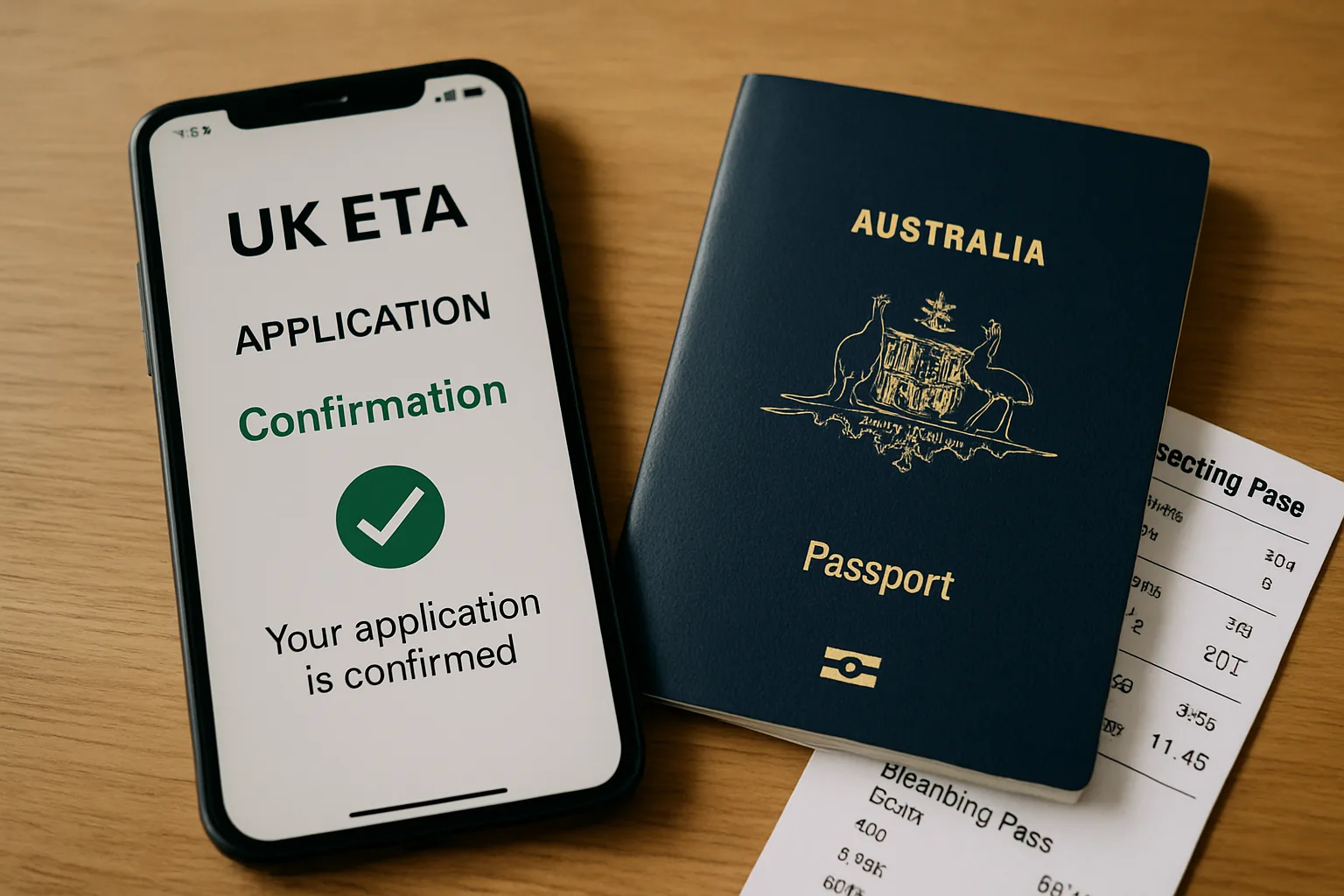
The cost is simple: £20 per application.
There are no hidden fees, no agency fees (unless you use a third-party service, which you shouldn't need to), and no additional charges. You pay £20 when you apply, and that's it. This is a flat rate regardless of your age or nationality, so an entire family of Australian passport holders will each pay £20 for their own ETA.
Payment is accepted via debit card, credit card, and various payment methods including Visa, Mastercard, American Express, and others. The charge will appear on your statement as a Home Office transaction. Keep your payment receipt and the reference number provided after payment—you'll need these if you need to check on your application status.
Processing time is where the UK ETA really shines compared to visas. Most applications are approved instantly—you'll see the decision on screen before you finish your coffee. Some applications go to manual review and take up to 3 working days.
If your application is flagged for manual review, you'll receive an email with your reference number and details about what information you provided.
Here's the important part: you must be approved before you travel. Don't assume you'll be approved at the gate if your application hasn't been processed yet. Always apply well in advance—at least 2 weeks before your flight, though in practice you can do it the day before if you're organised.
The longer your lead time, the more comfortable you can be.
Check how much does a UK ETA cost for a full breakdown of fees and payment methods. The official source is UK government's UK ETA page.
How to apply for a UK ETA as an Australian
The application process is straightforward. You do it all online on your phone, tablet, or computer in about 10 minutes.
Step 1: Gather your information
Before you start, have these ready:
- Your Australian passport (the valid one you'll be using to travel)
- A travel document image of your passport photo page (either scanned or photographed with your phone)
- Your contact details (email address, phone number)
- A debit or credit card for payment
Make sure your passport is valid for the duration of your stay in the UK. There's no rule about a specific validity period left on it—unlike some countries—but logically it needs to be valid when you travel. If your passport expires during your trip or shortly after, you can still apply, but consider renewing it first if it's due for renewal.
For the passport image, make sure it's clear and readable. The photo page should show your face clearly, your passport number, date of birth, and issue/expiry dates. If you're photographing it with your phone, use good lighting and avoid shadows or glare.
Step 2: Visit the official UK ETA website
Go to gov.uk/uk-eta and click the link to start your application. Avoid third-party websites offering to apply for you; they charge extra and the official process is genuinely simple. The official UK government website is the only place you should apply—it's secure, free of scams, and provides direct access to the Home Office system.
Bookmark the page or save the URL for your records. The official UK ETA page also contains helpful FAQs, updates about any system changes, and links to support if something goes wrong.
Step 3: Fill in the online form
The form asks for:
- Personal details (name, date of birth, nationality)
- Passport information (number, issue and expiry dates)
- Contact details (email, phone, address)
- Upload of your passport photo page
- Travel purpose (tourism, visiting friends/family, business meetings, transit)
Be honest and accurate. Errors on your form won't necessarily result in rejection, but they could cause delays or cause issues at the border. Double-check your passport number—that's the one piece of information the system matches against when you arrive in the UK.
Common errors include transposing digits or confusing your passport number with your Australian driver's licence number.
For your address, provide your current residential address in Australia or wherever you're living. This is purely for contact purposes; there's no requirement that you live in a specific place. If you've recently moved, use your most current address.
Step 4: Security questions
The application includes automated security questions designed to flag potential risks. These might ask about your criminal history, previous visa refusals, or health conditions. Answer honestly.
The system is automated and designed to identify genuine concerns, not to catch you out. Don't overthink the questions—just provide truthful answers.
The security screening is proportionate and fair. Trivial matters won't result in rejection, but serious issues (convictions, visa refusals for security reasons, etc.) may trigger manual review. If you have concerns about your eligibility, check the official UK ETA eligibility criteria before applying.
Step 5: Pay and submit
The cost is £20. You'll pay by debit or credit card (Visa, Mastercard, American Express, etc.). Once you submit, you'll be given a reference number.
Save this.
Your reference number is essential for tracking your application, contacting support if needed, and proving to airlines that you've applied (though the system will verify it directly). Write it down or take a screenshot of the confirmation page.
Step 6: Wait for approval
Most applications are approved instantly. You'll see the decision on screen. If your application goes to manual review, you'll hear within 3 working days, usually by email.
If you're approved, you're done. Your ETA is active and linked to your passport. You don't need to download anything or print anything.
An instant approval will display a message on screen confirming your ETA is valid, and you'll receive a confirmation email.
If your application is still pending after a few days and your flight is coming up, you can contact the UK Home Office support team via the gov.uk website using your reference number. They can provide an update on your status.
The UK ETA application requirements page covers the full details of what information you'll need and what happens after you apply. The official gov.uk guidance is the definitive source—bookmark it or save the reference number from your application.
What can you do with a UK ETA?
A UK ETA permits entry for specific purposes. Understanding what you're allowed to do is essential to avoid overstaying or breaching the conditions of your permit.
With a UK ETA, you can:
- Visit the UK as a tourist (sightseeing, cultural activities, attractions)
- Visit friends and family for social purposes
- Attend business meetings or conferences (but not work or receive payment)
- Participate in professional networking events
- Undertake short-term training or education (though this has limits—see below)
- Transit through the UK to another country
You cannot use an ETA to:
- Work or be employed (even unpaid or volunteer work has restrictions)
- Study at a UK university or college (you'd need a student visa)
- Establish a business or be self-employed
- Live in the UK permanently or semi-permanently
- Receive payment for services rendered in the UK
- Undertake paid training
Each permitted stay can last up to 6 months, but Border Force officers may restrict this based on your stated purpose. If you tell the border officer you're visiting for two weeks, trying to stay six months will be problematic. Be clear and honest about your intentions when entering the UK.
The ETA itself doesn't specify your permitted duration—this is determined by the Border Force officer who examines your passport at the border. They'll make a decision based on your circumstances, your stated purpose, and what evidence you have (hotel bookings, return flight, etc.). Always carry supporting documents for your trip's purpose.
Can you be rejected for a UK ETA?
Yes, though rejections are uncommon for Australian passport holders. Most rejections happen because:
- A criminal conviction (especially dishonesty, violence, or drugs offences)
- Previous visa refusal by the UK or other countries
- Security concerns flagged by international databases
- Incorrect information on your application that doesn't match official records
- Your passport is forged or has been reported lost/stolen
- Information about character concerns provided by foreign governments
- Outstanding debts to the UK government (rare but possible)
If you've got a clean record, an Australian passport in good standing, and no visa refusals, you're extremely likely to be approved. The ETA system is designed to be a streamlined route for genuine travellers from low-risk countries like Australia.
If your application is refused, you'll be given a reason. You can appeal or apply for a traditional visa if you believe the refusal is wrong. But this is rare for Australians.
If you're refused, the rejection letter will explain the grounds and your options for challenging the decision.
If you've been refused an ETA and believe it's an error, you can contact the UK Home Office to discuss it. Provide your reference number and explain your circumstances. Alternatively, you could apply for a Standard Visitor visa, which involves more detailed assessment and supporting documents, but allows for individual circumstances to be considered.
How to track your UK ETA application status
Once you've submitted your application, you'll want to know when it's approved. Tracking is straightforward, but there are a few things to know.
If your ETA is approved instantly (the most common scenario), you'll see the approval message on screen during your application. The confirmation will display immediately, and you'll receive a confirmation email to the address you provided. This means your ETA is active and you can travel.
If your application is flagged for manual review, you'll receive an email notification. The email will be sent to the address you provided on the form, so make sure you provide a current email address and check your spam folder if you don't see it. The email will include your reference number and details of next steps.
You can check your application status manually by visiting the UK ETA website and logging in with your reference number and email address. This page allows you to see the current status of your application at any time. You don't need to wait for an email—you can proactively check.
Most manual reviews are completed within 3 working days. If you're within a week of your flight and still waiting, you can contact the UK Home Office support team via the gov.uk website. They can provide an update and help expedite your application if possible.
Save your reference number somewhere safe—email it to yourself, write it down, take a screenshot. You'll need it to check your status or contact support.
Common mistakes Australian travellers make
Over the past months since the ETA rolled out, we've seen Australian travellers make the same few mistakes. Avoid them:
Mistake 1: Applying too late
Some Australians apply for their ETA a day or two before their flight and panic if it hasn't been instantly approved. Most are instant, but some go to manual review.
What to do: Apply at least 2 weeks before you travel. If you're within a week, you can still apply, but you're taking a risk if manual review is needed. Three weeks is ideal if you have the flexibility.
Mistake 2: Using the wrong passport
An ETA is linked to a specific passport number. If you get a new passport between applying and travelling, your old ETA won't work. You'll need a new one.
What to do: Apply once your new passport arrives if you're getting one before your trip. If you've already applied with your old passport and then got a new one, apply again with the new passport details. There's no penalty for having multiple ETAs on different passport numbers—just ensure you travel with the passport the ETA is linked to.
Mistake 3: Not realising it's valid for 2 years
Some Australians think they need a new ETA for each trip. You don't. Your ETA is valid for 2 years (or until your passport expires, whichever is sooner), so you can make multiple trips without reapplying.
What to do: Once approved, keep your reference number and passport safe. You don't need to apply again until your 2 years is up or your passport expires. If your passport expires within the 2-year period, your ETA expires with it, so you'll need a new ETA with your renewed passport.
Mistake 4: Assuming grace periods exist at the border
A few Australian travellers have assumed they could arrive without an approved ETA and sort it out at UK border control. Don't rely on this. Border Force will turn you away if you don't have an approved ETA.
What to do: Get your ETA approved before you leave Australia. It's cheap and takes minutes. Your airline will check for an approved ETA before allowing you to board, so you won't even make it to the gate without one.
Mistake 5: Using unofficial websites
Scammy websites prey on travellers by offering to apply for a UK ETA "on your behalf" and charging £50 or £100. The official ETA costs £20 and takes 10 minutes on the actual gov.uk website.
What to do: Only apply on gov.uk/uk-eta. It's free of scams because it's the real government website. If you see a website claiming to process ETAs and charging significantly more than £20, it's a third-party service and not the official route.
Mistake 6: Providing unclear passport photos
Some travellers upload blurry or poorly lit photos of their passport photo page, which can slow down processing or cause errors. The system needs to read your passport details clearly.
What to do: Ensure your passport photo page image is clear, well-lit, and readable. All text, numbers, and your photo should be visible without shadows or reflections. If you're unsure, retake the photo until you get a clear version.
What happens if you travel without a UK ETA?
Border Force will likely refuse you entry. You won't be allowed to board your flight to the UK if you don't have an approved ETA.
Airlines are required to check that you have the right travel authorisation before you board. If you don't have an approved ETA in the system, the airline will flag it and you'll be told to sort it out before your flight. This check happens at the gate or during check-in, so you'll discover the problem before you've travelled halfway to the airport.
If somehow you made it to UK border control without an approved ETA (unlikely), Border Force would refuse you entry. You'd be put on the next flight back to your home country at your own expense, and you'd likely be banned from entering the UK for a period of time. This ban would affect future visa or ETA applications and could impact your ability to travel to other countries.
This isn't meant to scare you—it's genuinely uncommon because the system is designed to catch this before you leave Australia. Your airline checks. Your boarding pass won't print without an approved ETA in the system.
But the bottom line is: don't travel without one.
The consequences of attempting to enter without authorisation are significant: you'll miss your trip, lose your flight costs, potentially be banned from UK entry for a period, and face questions from other countries' border authorities about the incident. The £20 and 10 minutes to apply is trivial compared to the headache of being denied boarding.
Special circumstances: Australians with dual citizenship or settled status
Some Australians hold dual citizenship or have special status in the UK. The rules differ depending on what else you hold.
Australians with British citizenship
If you hold both Australian and British passports, you don't need a UK ETA. You can enter the UK using your British passport as a British citizen. You have the right to enter and reside in the UK without any travel authorisation.
However, if you choose to use your Australian passport to enter the UK, you'll need an ETA. Border Force will only check one passport, so use your British passport if you have one and want to avoid the ETA requirement entirely.
Australians with UK settled status or pre-settled status
If you're an Australian who has been granted UK settled status or pre-settled status (usually through the EU Settlement Scheme if you were living in the UK before a certain date, or through other residence schemes), you don't need an ETA. Your settled status gives you the right to be in the UK without travel authorisation.
If you hold settled status, you'll have a document or digital record proving this. Carry it with you when you travel, though Border Force should be able to verify it on their system. If you're unsure whether you have settled status, contact the UK Home Office before your trip.
Australians returning to the UK after a long absence
If you previously lived in the UK and are returning after a long absence, you may have had a previous visa or indefinite leave to remain. If this status is still valid, you don't need an ETA. But if you're now a passport-holding visitor without special status, you'll need an ETA like any other Australian tourist.
If you're uncertain about your historical status, check your old passports or contact the UK Home Office for clarification. It's better to apply for an ETA unnecessarily than to assume you don't need one and arrive without authorisation.
What if your plans change after you've got your ETA?
Your UK ETA is flexible for short-notice changes. If you need to postpone your trip, cancel it, or change your travel dates, you don't need to do anything with your ETA.
Your ETA remains valid for 2 years, so you can use it whenever you travel during that window. You're not locked into specific travel dates. This flexibility is one of the major advantages of the ETA system over traditional visas, which are often issued for specific dates or durations.
The only scenario where you'd need a new ETA is if your passport changes—you get a new one, for example. Then apply again with your new passport number. The cost is another £20, but you'll have a fresh 2-year validity period.
If you decide not to travel to the UK at all, your approved ETA simply expires after 2 years or when your passport expires. There's no cancellation process or refund mechanism for unused ETAs.
If you cancel or postpone your trip and then want to travel later, you can use the same ETA without reapplying. This makes it ideal for travellers with flexible plans or multiple trips to the UK within a 2-year window.
What to do if your UK ETA is refused or cancelled
Refusals are rare for Australians, but if it happens, you have options. Understanding what to do next is important.
If your ETA application is refused, you'll receive a decision letter explaining the grounds for refusal. The letter will outline your legal options, which typically include:
- Requesting an administrative review of the decision
- Applying for a traditional Standard Visitor visa instead
- Contacting the UK Home Office to discuss the grounds for refusal
Administrative review is a process where the Home Office reconsiders your application if you believe there's been an error or misunderstanding. You can submit additional information or clarification to support your case. This process takes additional time (weeks, not days) and may incur additional costs.
Alternatively, you can apply for a Standard Visitor visa, which is a more formal visa application process. This allows you to provide detailed supporting documents, explain your circumstances in more detail, and potentially appeal the decision through the immigration tribunal system if refused again. A visa application is more expensive (£100+), takes longer (2-3 weeks), and requires supporting documents, but it provides a more thorough assessment of your eligibility.
If your ETA is cancelled after approval (very rare), you'll be notified and given a reason. Grounds for cancellation might include discovered security concerns, criminal activity, or fraudulent information on your application. Cancellation after travel is unlikely unless something serious emerges.
Preparing for your UK journey: Document checklist and final steps
Once your ETA is approved, you're nearly ready to travel. But before you board that flight, take these final steps to ensure smooth entry.
Your travel document checklist
Before you travel, ensure you have:
- Your valid Australian passport (the one your ETA is linked to)
- Your ETA reference number saved (email it to yourself or write it down)
- Return or onward flight confirmation
- Evidence of accommodation (hotel booking, address of friends/family you're visiting)
- Proof of financial means (credit card, bank statement, or similar)
- Your travel insurance details (highly recommended)
- Any specific documents for your trip purpose (conference registration, business meeting invitation, etc.)
While you don't technically need to carry most of these documents, having them available makes border crossing smoother. Border Force may ask about your plans, and having evidence demonstrates you're a genuine traveller with legitimate purpose.
Before you board your flight
When you check in for your flight to the UK, the airline will verify that you have an approved ETA. This is an automatic system check, not a manual review by the airline staff. If there's an issue, you'll be told at check-in and must resolve it before you can board.
Don't contact the airline to ask about your ETA status—contact the UK Home Office directly via gov.uk if you have concerns. Airlines don't have access to ETA information; they only check that it exists in the system.
Ensure your passport is in good physical condition. Damaged passports can sometimes cause problems at border control, even if they're technically still valid. If your passport is heavily worn or has damaged pages, consider renewing it before your trip.
At UK border control
When you arrive at UK border control, present your passport to the border officer. They'll verify your approved ETA on their system and may ask you questions about your visit, purpose, and how long you're staying. Answer honestly and provide brief, clear answers.
Have your accommodation details, return flight information, and proof of financial means readily accessible. You may not be asked for these, but having them readily available speeds up the process if you are.
The border officer will determine how long you're permitted to stay on your visit. This is typically up to 6 months, but they may restrict it based on your stated purpose and evidence. If you say you're visiting for two weeks, you'll likely be admitted for about that period.
Once you've passed border control, you're free to travel within the UK. Your ETA has done its job, and you now have a visa-free stay under whatever duration the border officer specified.
Key takeaways
- Australian passport holders must have a UK ETA to visit the UK (unless you hold British citizenship or a right of abode)
- The ETA is cheap and fast—£20, usually approved in minutes, applied for entirely online
- Apply well in advance—at least 2 weeks before your trip to avoid any delays
- It's valid for 2 years—you can make multiple trips to the UK without reapplying
- Avoid third-party websites—apply directly on gov.uk; it's free and simple
- You won't be allowed to board without an approved ETA—airlines check before you leave Australia
- Check official sources before you travel—this article is general guidance; the UK government's ETA page is the definitive source
Official sources
Check the authority for current fees and requirements before applying.
Frequently asked questions
Do I need a UK ETA if I'm an Australian with dual British citizenship?
How long is a UK ETA valid for?
Can I apply for a UK ETA on my phone?
What should I do if my UK ETA application is rejected?
Do I need to print my UK ETA or carry it with me?
This article is for general informational purposes only. Visa and travel authorisation rules change frequently. Always check the official government website before travelling.

Written & reviewed by
Can OTUTravel Authorisation Editor
Can OTU is the editor of ETA Travel Assistant, specialising in UK ETA, Schengen ETIAS, NZeTA and ESTA travel authorisations. Can monitors official government sources and policy updates to ensure every guide is accurate, current and genuinely useful for travellers.
View all guides →