Do EU Citizens Need a UK ETA, and How Do They Apply?
- Apply online before you travel (processing takes under 3 days).
- The ETA costs £20 (around €23) and is valid for 2 years.
- Irish citizens and those with UK settled status are exempt.
The UK introduced the Electronic Travel Authorisation (ETA) as part of its new border system. EU citizens who previously visited the UK visa-free now need this pre-travel permission. But don't worry — the process is quick, cheap, and done entirely online.
This guide explains exactly who needs an ETA, how to apply step by step, what it costs, and what to do if your application is denied. We'll also cover key exemptions so you know whether you need to apply or not.
Remember: this information is general guidance. Always check official sources before you travel. The rules can change, and it's your responsibility to have the correct documents.
Do EU Citizens Need a UK ETA?
Yes, from 2025, EU citizens (except those with certain exemptions) must get a UK ETA before travelling to the UK for short stays. This includes trips for tourism, business, visiting family, and even transit through a UK airport.
The ETA requirement applies to all EU member states. That's 27 countries, from Austria to Sweden, plus the other EEA countries (Iceland, Liechtenstein, Norway) and Switzerland.
If you're an EU citizen and you plan to visit the UK for up to 6 months (or a short stay for a specific purpose), you'll likely need an ETA. There are a few exceptions — see the exemptions section below.
For a concrete example, consider Maria from Spain. She wants to spend two weeks visiting London and Edinburgh in June 2025. She will need an ETA before she books her flight.
Similarly, Hans from Germany who plans a weekend shopping trip to Manchester must also apply in advance. Even Pierre from France who is simply changing planes at Heathrow en route to New York will need an ETA for transit, unless he stays airside and qualifies for an exemption. The system covers almost all short-term purposes.
Business travellers are not exempt either. An EU citizen attending a conference in Birmingham or meeting clients in Glasgow must hold a valid ETA. The only exception is if they hold a specific work visa.
Short business activities such as negotiations, fact-finding, or training are permitted under the ETA scheme, but paid work is not. This means a consultant from Italy giving a paid training session would need a different visa.
For more details on who specifically needs an ETA, check our full guide on who needs a UK ETA.
What Is a UK ETA?
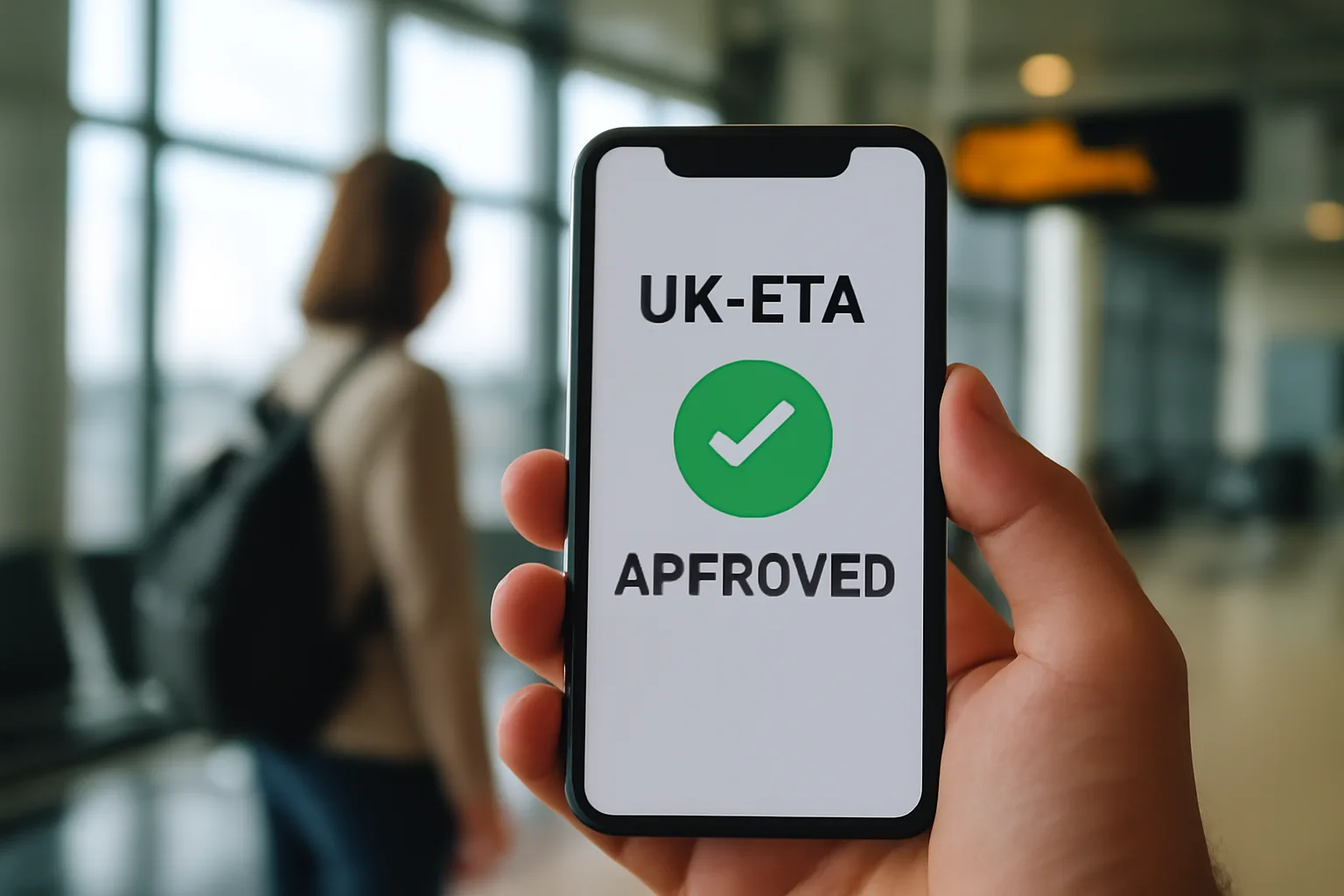
The UK ETA is a digital travel authorisation. It's not a visa — it's a quicker, simpler permission that allows visa-exempt nationals to enter the UK for short stays. The ETA is electronically linked to your biometric passport.
You apply online, pay a small fee, and usually get a decision within a few days. Once approved, your ETA is valid for 2 years or until your passport expires (whichever comes first). During that time you can make multiple visits to the UK, each stay up to 6 months.
Think of it as a security check before you arrive. It helps Border Force know who's coming and prevents people from being turned away at the border.
The system is similar to the US ESTA or the Canadian eTA. It is not a visa application, so there is no need for an interview or biometric appointment. All data is submitted online, and the system cross-references your details against security databases.
If no red flags are raised, approval comes quickly.
The ETA is mandatory for entry. Airlines and ferry operators will check your ETA status before you board. If you do not have an approved ETA, you may be denied boarding.
Even if you manage to travel without one, Border Force will refuse you entry at the port of arrival.
Differences Between a UK ETA and a UK Visa
Many EU citizens confuse the ETA with a traditional visa, but they are fundamentally different. A visa is typically required for longer stays, work, study, or settlement, and involves a more detailed application process with supporting documents and often an interview.
The ETA is a lighter authorisation. It covers only short visits for tourism, business, study under 6 months, and transit. The application form is short, the fee is low, and there is no requirement to submit bank statements, invitation letters, or travel itineraries.
For example, a student from Poland who wants to attend a two-month English course in London needs an ETA. But a student enrolling in a full three-year degree programme needs a Student visa. Similarly, a consultant from Sweden giving a one-hour paid talk needs a work visa, not an ETA.
If you are unsure which you need, the UK government website provides a simple tool. You enter your nationality, purpose of travel, and intended length of stay. The tool tells you whether you need an ETA, a visa, or neither.
Always use this tool before making bookings.
Step-by-Step Application Process for EU Citizens

Applying for a UK ETA is straightforward. Follow these steps:
- Check your passport. You need a valid biometric EU passport that's valid for at least 6 months from your date of arrival in the UK. If your passport doesn't have the bio icon (or is expiring soon), renew it first. You cannot use an emergency travel document or a temporary passport for an ETA application.
- Gather your information. You'll need your passport, an email address, a debit or credit card, and (in some cases) details of your travel plans and employers. Have them handy. If you are self-employed, you may be asked for your business name and address. If you are a student, you may need your school's name.
- Go to the official UK ETA application website — use the UK government's secure portal. Beware of unofficial third-party sites that charge extra fees. Some of these sites look official but add hidden charges of £50 or more. Always check the URL ends in gov.uk.
- Fill in the online form. You'll provide personal details, passport information, and answer some basic security questions. The form takes about 10 to 20 minutes. You will be asked about your travel history, any criminal convictions, and past immigration violations. Answer truthfully.
- Pay the fee. The current fee is £20 (approximately €23). You can pay by credit card, debit card, or other digital payment methods such as Apple Pay or Google Pay. The system accepts most major cards, including Visa, Mastercard, and American Express.
- Submit your application. After paying, you'll get a confirmation email. Most applications are approved within minutes to 3 days. You'll receive a second email with the decision. Check your spam folder if you do not see it within an hour.
- Check your ETA is linked to your passport. If approved, the ETA is digital — you don't need to print anything. When you board your flight or arrive at the border, the system will automatically check your passport against the ETA database. You may want to screenshot the approval email as a backup, though it is not required.
That's it. You're ready to travel. Just remember to use the same passport you applied with.
If you renew your passport during the ETA's validity period, the authorisation is cancelled and you must reapply.
For a complete list of required documents and details, see our guide on UK ETA application requirements.
Practical Tips for a Smooth Application
Double-check every field before submitting. A simple typo in your name or passport number can cause delays or a denial. Compare your passport details carefully as you type.
Use an email address you check regularly. You may need to receive updates or respond to a follow-up query from UKVI. If the system cannot reach you, your application may be delayed or rejected.
Apply at least one week before your departure if possible. While most decisions come within 72 hours, peak travel seasons or system issues can cause delays. An early application gives you a safety buffer.
What Documents Do You Need?
To apply for a UK ETA as an EU citizen, you need:
- A valid biometric passport from an EU country. It must be valid for at least 6 months from your planned arrival in the UK. If your passport expires in 4 months, you cannot use it for an ETA application.
- An email address to receive your confirmation and decision. Use a reliable provider like Gmail, Outlook, or Yahoo.
- A payment method (credit or debit card, or other online payment). The system does not accept cash, bank transfers, or cryptocurrency.
- You may also be asked for your planned travel dates, accommodation address, and employer details (if travelling for work). Have these ready. If you are staying with friends or family, you do not need an invitation letter, but you should know their address.
You do not need to submit a photo or fingerprints. The ETA is linked to your passport's chip data. This makes the process faster and more convenient compared to a traditional visa application.
If you hold a second passport from a non-EU country, you can apply using either. However, you must use the same passport for travel. You cannot switch passports after the ETA is issued.
How Much Does a UK ETA Cost for EU Citizens?
The UK ETA costs £20 (around €23 at current exchange rates). This fee is set by the UK government and is the same for all nationalities. There are no discounts for minors, students, or senior citizens.
There are no additional charges for processing. You pay once and the ETA lasts for 2 years (or until your passport expires). The fee is non-refundable even if your application is denied, so ensure your details are correct before submitting.
Be careful: some unofficial websites charge higher fees for the same service. Always use the official UK government website to avoid extra costs. These third-party sites often charge £50 or more for the same service.
For more details on fees and payment methods, check our page on how much does a UK ETA cost.
How Long Does It Take to Get an ETA Decision?
Most ETA applications are processed within minutes to 3 days. Many travellers receive a decision within a few hours. However, it's wise to apply at least 72 hours before your trip to allow for delays.
Some applications are approved in as little as 10 minutes.
You'll get an email confirming the outcome. If your application is approved, you're good to go. If it's denied, the email will explain why and whether you can reapply or need a visa instead.
Do not assume that a denial means permanent exclusion — many issues are fixable.
Processing times can vary if your application requires additional checks. In rare cases, it may take up to a week. So don't leave it until the last minute.
If you are travelling at a peak time like Christmas or summer holidays, apply even earlier.
Factors that can slow down processing include: incomplete forms, mismatched passport data, a common name that triggers manual review, or a criminal record that requires further assessment. If you have a prior UK immigration violation, expect extra scrutiny.
What to Do If the Decision Is Delayed
If you have not heard back within 7 days, contact UKVI for an update. You can check the status online using your application reference number. Do not reapply while a previous application is pending, as this can cause confusion.
If you need to travel urgently and the ETA is still pending, you may have to postpone your trip. There is no expedited processing for ETAs. Consider applying for a visitor visa as a backup if time allows.
What If Your UK ETA Is Denied?
If your ETA application is denied, the email will state the reason. Common reasons include:
- Inaccurate or incomplete information in the form. A typo in your date of birth or passport number can trigger a denial.
- A criminal record that raises security concerns. Serious offences like violent crimes or drug trafficking may lead to refusal.
- Previous UK immigration violations (e.g., overstaying a visit). Even a short overstay of a few days can cause a denial.
- The system couldn't verify your identity or passport details. This can happen if your passport chip is damaged or unreadable.
You can usually reapply with corrected information. If the denial is based on something more serious (like a criminal conviction), you may need to apply for a standard visitor visa instead. There is no formal appeal process for an ETA refusal, but you can always contact UKVI for guidance.
If you are denied an ETA close to your travel date, contact the UK embassy or consulate in your home country for advice on alternative options. In some cases, a visitor visa can be processed quickly if you explain the urgency.
For example, Ana from Portugal was denied an ETA because she accidentally entered her passport number incorrectly. She reapplied with the correct number and was approved the next day. Marco from Italy was denied because of a previous overstay, so he applied for a visitor visa and was granted entry after a more thorough review.
Key Exemptions: Who Does Not Need a UK ETA?
Some EU citizens are exempt from the ETA requirement. You do not need an ETA if:
- You are an Irish citizen (you have the right to live and work in the UK under the Common Travel Area). Irish passport holders can enter the UK freely without any pre-authorisation. This also applies to dual citizens who hold an Irish passport.
- You hold UK settled status (Indefinite Leave to Remain, or EU Settled Status). You can use your residency document or digital status to enter. This status also covers family members who hold a biometric residence card.
- You already have a UK visa (e.g., a work visa or student visa) – that visa itself gives you entry permission. You do not need an additional ETA alongside a valid visa.
- You are a British citizen (you have the right of abode). British citizens are never required to apply for an ETA, regardless of whether they hold another nationality.
- You are transiting through the UK airside (staying in the international transit area) – but note: from 2025, transit without an ETA may be restricted; check the official rules before you travel. For example, if you are flying from Paris to New York with a layover at Heathrow and you do not pass through border control, you may be exempt. But if you need to switch airports or leave the transit zone, you will need an ETA.
If you are not sure whether you qualify, follow the link to who needs a UK ETA for a complete list of exemptions and nationalities.
Validity Period and Renewal of the UK ETA
The UK ETA is valid for 2 years from the date of approval, or until your passport expires, whichever comes first. If your passport has only 1 year of validity left, the ETA will last for 1 year, not 2.
During the validity period, you can make unlimited visits to the UK. Each stay can be up to 6 months. You can leave and re-enter as many times as you like, as long as the ETA remains active.
When your ETA expires, you must apply for a new one. There is no renewal process — you simply submit a fresh application. The fee remains the same (£20) and the process is identical to a first-time application.
For example, if your ETA is approved on March 1, 2025, it will expire on March 1, 2027, unless your passport expires sooner. If you renew your passport in March 2026, the ETA is cancelled and you must reapply with the new passport.
Keep track of your ETA expiry date. Mark it on your calendar or set a reminder. Travelling with an expired ETA can result in denial of boarding or entry.
Impact of the UK ETA on EU Citizens in Transit
Many EU citizens travel through the UK to reach other destinations. If you are transiting through a UK airport, you may need an ETA, depending on your specific route and whether you stay airside.
If you stay in the transit lounge and do not pass through UK border control, you may not need an ETA. However, this exemption is being reviewed. From 2025, even airside transit may require an ETA for many nationalities.
If you need to change airports, leave the airport, or collect baggage, you must pass through border control. In that case, an ETA is essential. For example, if you fly from Amsterdam to London Heathrow, then take a separate flight to Dublin with a change of terminal, you will need an ETA.
Always confirm the transit rules with your airline before booking. Airlines are responsible for checking documentation and may refuse boarding if you lack the required authorisation.
Common Mistakes EU Citizens Make When Applying for a UK ETA
Many EU citizens make simple errors that lead to delays or denials. One common mistake is entering the passport number incorrectly. The ETA system requires the exact number printed on your passport including all letters and digits.
Another frequent error is using an invalid or expired passport. If your passport is due to expire within 6 months of your travel date, you must renew it first. Applying with a short-validity passport will result in a denial.
Some people apply through third-party websites that charge extra fees. These sites may also delay your application by not submitting it immediately. Always use the official UK government website ending in gov.uk.
Another mistake is failing to check the spam folder for the decision email. Many travellers miss their approval because it lands in spam. Check all folders regularly after applying.
Finally, some travellers assume that an ETA guarantees entry. It does not. Border Force has the final say.
You must still satisfy the officer that you meet the entry requirements, including proof of return travel, sufficient funds, and no intention to work illegally.
Frequently Asked Questions
1. Do EU citizens need a UK ETA if they have dual nationality with another ETA-eligible country?
If you hold a second passport from a country that also requires an ETA (e.g., US, Canada, Australia), you can use either passport to apply. However, you must apply with the passport you intend to use to enter the UK. You cannot hold two ETAs for different passports.
2. Can EU citizens apply for a UK ETA at the border?
No, you must apply and receive approval before you travel to the UK. There is no on-arrival ETA. Border Force will check your ETA status when you arrive, and if you don't have one, you may be refused entry.
3. Is a UK ETA the same as the EU's ETIAS?
No. The UK ETA is for travel to the United Kingdom. ETIAS is a separate system for travel to the Schengen Area (European countries). They are not interchangeable.
EU citizens will need ETA for the UK, and UK citizens will need ETIAS for Europe.
4. What happens if my EU passport expires but my UK ETA is still valid?
Your ETA is automatically cancelled when your passport expires. You will need to apply for a new ETA with your new passport. There is no way to transfer an existing ETA to a new passport.
This applies even if you renew your passport early.
5. Can EU citizens work in the UK with an ETA?
No. The ETA only allows tourism, business activities (like meetings, conferences, or training), study of up to 6 months, and short family visits. It does not permit paid work, long-term study, or establishing a business. For work, you need a relevant work visa.
6. Do children from EU countries need a separate UK ETA?
Yes, each traveller requires their own ETA, including infants and children. You apply for each child individually using their own passport. There is no family application option.
The fee is the same £20 per person.
7. Can I change or update my ETA after it is approved?
No, you cannot modify an approved ETA. If your passport details change or you make a mistake, you must cancel the ETA and reapply. You cannot update your travel dates or personal information after approval.
Key Takeaways
- From 2025, most EU citizens need a UK ETA for short visits up to 6 months.
- Apply online at least 3 days before travel; cost is £20; validity is 2 years.
- Irish citizens, those with UK settled status, and holders of UK visas are exempt.
- Always use the official UK government website to apply and check current requirements.
- If your ETA is denied, you can reapply or consider a visitor visa; contact UKVI for advice.
For authoritative information, visit the UK government ETA guidance page.
This article is for general informational purposes only and does not constitute legal or professional immigration advice. Rules and fees may change. Always verify with official sources before making travel arrangements.
Frequently asked questions
Do EU citizens need a UK ETA if they have dual nationality with another ETA-eligible country?
Can EU citizens apply for a UK ETA at the border?
Is a UK ETA the same as the EU's ETIAS?
What happens if my EU passport expires but my UK ETA is still valid?
Can EU citizens work in the UK with an ETA?
This article is for general informational purposes only. Visa and travel authorisation rules change frequently. Always check the official government website before travelling.

Written & reviewed by
Can OTUTravel Authorisation Editor
Can OTU is the editor of ETA Travel Assistant, specialising in UK ETA, Schengen ETIAS, NZeTA and ESTA travel authorisations. Can monitors official government sources and policy updates to ensure every guide is accurate, current and genuinely useful for travellers.
View all guides →