ETIAS Application Requirements: Full Document Checklist

- You must have a biometric passport valid for at least 3 months beyond your intended stay.
- You'll provide personal data, travel history, and answer security questions online.
- The application takes about 10 minutes and costs €20; approval is usually within minutes.
If you're planning a trip to the Schengen Area, you've probably heard about ETIAS – the European Travel Information and Authorisation System. It's a new entry requirement for visa-exempt travellers, launching in mid-2025. But what exactly do you need to apply?
This article breaks down every requirement, step by step.
ETIAS is not a visa. It's a travel authorisation, similar to the US ESTA or UK ETA. You apply online, pay a small fee, and get approval before you travel.
The whole process is digital – no paperwork, no embassy visits. But you still need to meet specific requirements. Here's your complete checklist.
We'll cover everything: passport requirements, personal information, travel history, security questions, fees, and what happens after you apply. By the end, you'll know exactly what documents and details to have ready. And remember – this is general guidance.
Always check official sources before you travel.
What is ETIAS? A Quick Refresher
ETIAS stands for European Travel Information and Authorisation System. It's an electronic travel authorisation for citizens of countries that currently do not need a visa to visit the Schengen Area. That includes the UK, the US, Canada, Australia, New Zealand, Japan, and many others.
Once ETIAS is operational – currently expected in mid-2025 – travellers from these countries will need to obtain an ETIAS authorisation before boarding a flight, ferry, or coach to any Schengen country. It's not a visa, but a pre-screening to identify potential security or migration risks.
You apply online, pay a €20 fee (for most applicants), and typically receive a decision within minutes. The authorisation is valid for 3 years or until your passport expires, whichever comes first. You can use it for multiple trips, with stays up to 90 days in any 180-day period.
For more on the timeline, check out our guide on when does etias start.
ETIAS Application Requirements: The Full Checklist
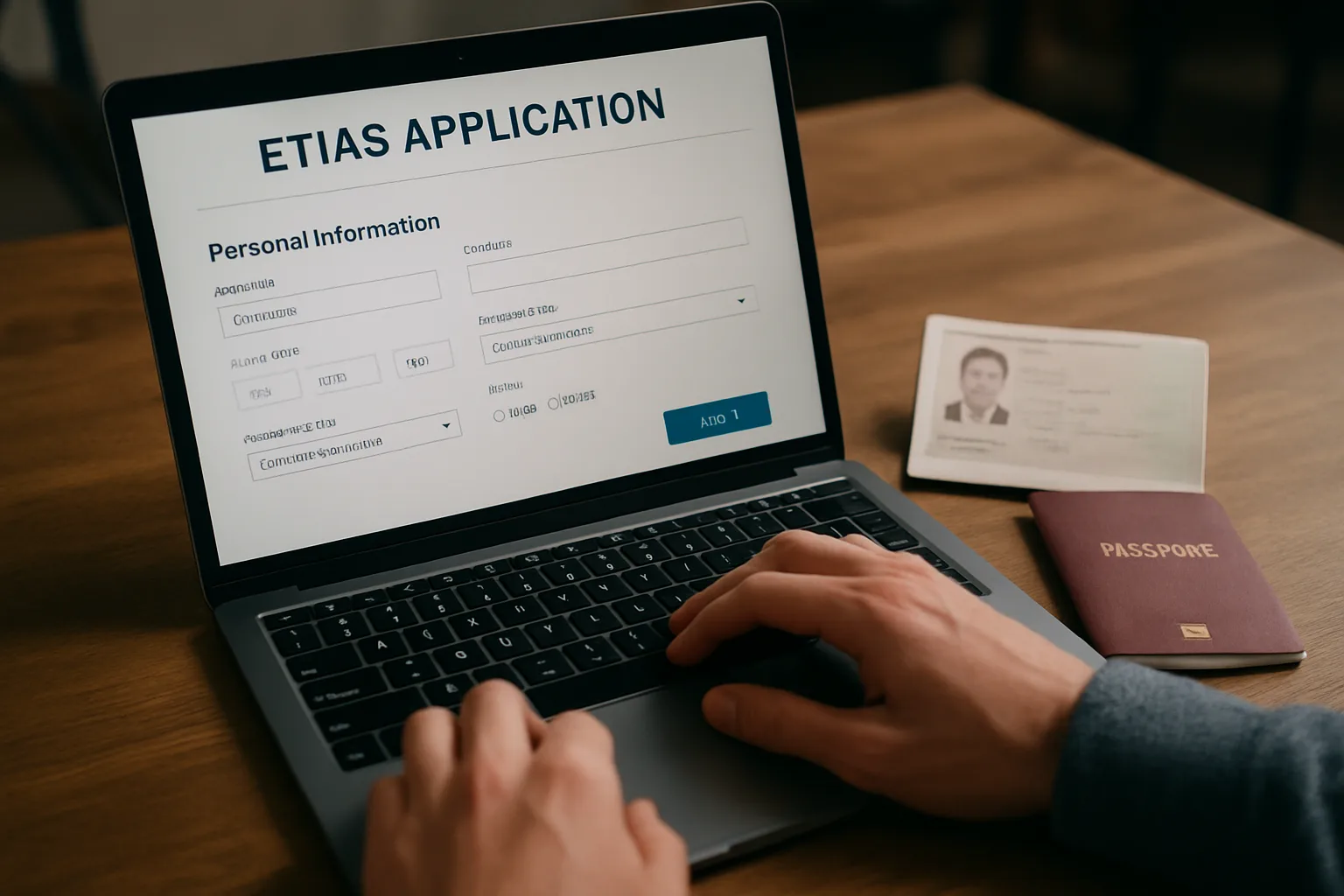
Before you start your application, gather the following. You'll need them all to complete the form.
1. A Valid Biometric Passport
This is the most important requirement. Your passport must be:
- Biometric – meaning it has a digital chip containing your photograph and personal data. Most passports issued since the late 2000s are biometric. If you have an older non-biometric passport, you may need to renew it before applying.
- Valid for at least 3 months beyond your intended departure date from the Schengen Area. For example, if you plan to leave on 1 October 2025, your passport must be valid until at least 1 January 2026.
- Issued by a country that is visa-exempt for Schengen travel. If you hold a passport from a country that needs a visa, you cannot use ETIAS – you'll need a Schengen visa instead.
If you have dual nationality, use the passport you intend to travel with. You must apply for ETIAS using the same passport you'll present at the border.
2. Personal Information
The ETIAS application asks for basic personal details. Have these ready:
- Full name (as it appears on your passport)
- Date and place of birth
- Gender
- Nationality (the country that issued your passport)
- Home address
- Email address (for the confirmation and approval)
- Phone number (optional but recommended)
No proof of address is required. You just type it in.
3. Passport Details
You'll need to enter the following from your passport's data page:
- Passport number
- Issue date
- Expiry date
- Country of issue
Double-check these – a typo could cause problems at the border.
4. Travel History and Destination
ETIAS asks about your travel plans and past travel. You'll need:
- First Schengen country you plan to visit – this is your point of entry. If you're visiting multiple countries, list the first one.
- Previous travel to conflict zones or high-risk areas – you may be asked if you've visited certain countries in the past 10 years. Be honest.
- Deportation or visa refusal history – you'll be asked if you've ever been refused entry or deported from any country. Again, honesty is best.
You don't need to provide proof of flights or accommodation at this stage. ETIAS is not a visa – it's a pre-authorisation. You can book your trip before or after applying.
5. Security Questions
The application includes a few yes/no questions about:
- Criminal convictions (especially serious crimes like terrorism, trafficking, or sexual offences)
- Membership in terrorist or criminal organisations
- Previous deportation or removal orders
These are standard security screening questions. Answer truthfully. If you answer yes, your application may be referred for manual processing, which could take longer.
6. Fee Payment
The ETIAS application fee is €20 for most applicants. The fee is waived for:
- Applicants under 18 years old
- Applicants over 70 years old
You can pay with a debit or credit card (Visa, Mastercard, etc.) during the online application. The payment is processed securely.
What Documents Do You NOT Need?
ETIAS is designed to be simple. You do NOT need to provide:
- Passport photos or biometric data (your passport chip already has this)
- Proof of travel insurance
- Proof of accommodation or flight bookings
- Bank statements or proof of funds
- Employment letters or sponsorship documents
- Invitation letters
- Medical certificates
None of these are required for ETIAS. But remember – border officers may still ask for some of these when you arrive in Schengen. ETIAS is just the entry authorisation; border control has its own checks.
Step-by-Step Application Process
Here's how the application works in practice:
- Go to the official ETIAS website (or the official mobile app). Beware of third-party sites that charge extra fees.
- Complete the online form with your personal details, passport info, and travel plans. This takes about 10 minutes.
- Answer the security questions honestly.
- Pay the fee (€20 for adults, free for under-18s and over-70s).
- Submit the application. Most are processed automatically within minutes. You'll receive an email confirmation.
- Check your email for the ETIAS approval. It's linked electronically to your passport – you don't need to print anything, but it's wise to carry a copy.
If your application is flagged for manual review, it could take up to 14 days. Apply well before your trip – at least a month in advance is recommended.
ETIAS for Different Traveller Groups
British Citizens
Since Brexit, British citizens are visa-exempt for short stays in Schengen. But you'll need ETIAS once it launches. The requirements are the same as for any other visa-exempt traveller.
For more details, see our article on etias british citizens.
Families and Children
Children under 18 need their own ETIAS authorisation. The fee is waived for minors, but you still need to submit an application for each child. Parents or guardians can apply on their behalf.
You'll need the child's passport details and basic personal info. For a full guide, see etias children families.
Dual Nationals
If you hold two passports, you must apply with the one you'll use for travel. If one of your nationalities requires a Schengen visa, you cannot use ETIAS – you'll need a visa instead. Choose the passport that gives you visa-free access.
ETIAS vs Schengen Visa: Key Differences
It's easy to confuse ETIAS with a Schengen visa, but they are very different. Here's a quick comparison:
| Feature | ETIAS | Schengen Visa |
|---|---|---|
| Who needs it? | Visa-exempt nationals | Visa-required nationals |
| Application process | Online only, 10 minutes | In-person at embassy/consulate |
| Documents required | Passport, personal details | Passport, photos, insurance, itinerary, bank statements, etc. |
| Fee | €20 (free for under-18s and over-70s) | €80 (adults), varies for children |
| Processing time | Minutes (up to 14 days if manual review) | 15-45 days (sometimes longer) |
| Validity | 3 years or until passport expiry | Up to 90 days per visit (typically single or multiple entry) |
For a deeper dive, read our comparison: etias vs schengen visa.
What Happens After You Apply?
Once you submit your application, the ETIAS system checks your details against security databases (like Interpol, Europol, and Schengen Information System). Most applications are approved instantly. You'll receive an email with your ETIAS approval, which is linked to your passport number.
When you travel, the airline or ferry company will check your ETIAS status before boarding. At the border, the officer may scan your passport and see the authorisation. You don't need to present a printed document, but it's a good idea to have a copy on your phone or in your bag.
If your application is refused, you'll receive a reason and can appeal. Refusals are rare for genuine travellers, but can happen if you have a criminal record or security concerns.
Common Mistakes to Avoid
Here are the most frequent errors people make on their ETIAS application:
- Using a non-biometric passport – check your passport has a chip symbol on the cover.
- Entering passport details incorrectly – a typo in the passport number can cause delays or refusal.
- Waiting until the last minute – even though most approvals are instant, manual reviews can take up to 14 days. Apply at least a month before travel.
- Using a third-party website – only use the official ETIAS website. Unofficial sites may charge extra or misuse your data.
- Assuming ETIAS covers all Schengen countries – it does, but you must enter through the first country you listed. If you change your plans, you can update your application (for free).
Frequently Asked Questions
Do I need a printed copy of my ETIAS?
No. ETIAS is electronically linked to your passport. But carrying a printed copy or a screenshot can help if there's a system glitch.
Can I apply for ETIAS if my passport expires soon?
Yes, but your ETIAS will expire when your passport does. If you renew your passport, you'll need a new ETIAS.
What if I make a mistake on my application?
You can correct minor errors (like a typo) by reapplying. But if you've already been approved, you may need to submit a new application. Contact the ETIAS helpdesk for guidance.
Do I need ETIAS for a layover in Schengen?
Yes, if you will pass through border control. If you stay airside in a transit zone, you may not need it, but check with your airline. For most travellers, any entry into Schengen requires ETIAS.
Is ETIAS valid for all Schengen countries?
Yes. Once approved, you can travel to any of the 27 Schengen countries (plus a few microstates) for up to 90 days in any 180-day period.
Key takeaways
- ETIAS is not a visa – it's a quick online authorisation for visa-exempt travellers.
- You need a valid biometric passport with at least 3 months validity beyond your stay.
- Application is online only – no paperwork, no embassy visit.
- Fee is €20 (free for under-18s and over-70s).
- Apply early – at least a month before travel to allow for manual processing.
- Always check official sources before your trip – requirements can change.
Understanding Your Biometric Passport in Detail
Your biometric passport, also known as an e-passport, contains an embedded microchip. This chip stores your digital photograph, name, date of birth, and other personal data.
Look for the international e-passport symbol on the cover – it resembles a small camera or rectangle. If your passport lacks this chip, you cannot use it for ETIAS.
For example, a UK passport issued after 2006 is biometric. A US passport issued after 2007 also meets the standard. Older passports may need renewal before you apply.
Always verify your passport's chip is functioning. Damaged chips can cause issues at automated border gates.
How to Prepare Your Personal Information for the Application
Write down your full name exactly as printed on your passport. Middle names must be included if they appear.
Your date of birth should match the passport record. Use the format day-month-year, such as 15-03-1985.
For your home address, provide your current residence. This can be different from your permanent address if you are travelling.
Double-check your email address for typos. The ETIAS confirmation and approval will be sent there.
Keep your phone number handy for optional contact. It helps if the system needs to verify your identity.
Entering Passport Details Without Errors
Transcribe your passport number carefully – it may include letters and numbers. For example, a UK passport number is nine characters long.
Check the issue and expiry dates on your passport's data page. These are often printed in a specific format, like DD/MM/YYYY.
If you make a mistake, your application may be delayed. In some cases, you might need to reapply entirely.
Scan or photograph your passport data page for reference. This helps you avoid errors when typing.
Providing Travel History and Destination Information
List the first Schengen country you plan to enter. This could be France, Germany, Italy, or any other member state.
If you are visiting multiple countries, only the first one is required. The system does not need your full itinerary.
Be honest about previous travel to conflict zones. For instance, if you visited Syria or Iraq in the last 10 years, disclose it.
Similarly, report any visa refusals or deportations. Hiding this information can lead to a refusal or future bans.
You do not need to upload supporting documents for travel history. The system only records your answers.
Answering Security Questions Accurately
The security questions cover criminal convictions, terrorist associations, and deportation orders. Each question requires a simple yes or no answer.
If you answer yes to any question, your application may be reviewed manually. This can take up to 14 days.
For example, a past conviction for theft might trigger additional checks. A terrorism-related conviction would almost certainly lead to refusal.
Always answer truthfully – false statements can result in entry denial. The ETIAS system cross-references your answers with international databases.
Paying the ETIAS Fee
The standard fee is €20 for applicants aged 18 to 70. Under-18s and over-70s pay nothing.
Payment is made online with a debit or credit card. Accepted cards include Visa, Mastercard, American Express, and Maestro.
The payment page is secure and encrypted. You will receive a receipt after successful payment.
If your payment fails, check your card details or contact your bank. Some international transactions may be blocked.
Understanding the ETIAS Approval Process
After submission, the system automatically checks your details. Most applications are approved within minutes.
If your application is flagged, it enters manual processing. This involves a human officer reviewing your case.
Manual reviews can take up to 14 days. You will receive an email with the decision.
Approved ETIAS is valid for 3 years or until your passport expires. You can travel to any Schengen country during this period.
If your application is refused, you will receive a reason. You can appeal the decision through the official process.
ETIAS for Students and Researchers
Students from visa-exempt countries need ETIAS for short-term study. This includes courses under 90 days.
If you plan to study longer than 90 days, you may need a student visa instead. Check with the embassy of your destination country.
Researchers attending conferences or workshops also require ETIAS. The authorisation covers academic activities.
No additional documents are needed for study purposes. The standard ETIAS application suffices.
ETIAS for Business Travellers
Business travellers from visa-exempt countries must obtain ETIAS. This covers meetings, conferences, and negotiations.
If you plan to work or receive payment in Schengen, you may need a work visa. ETIAS does not permit employment.
For example, attending a trade fair in Germany requires ETIAS. Working as a consultant in France would need a visa.
Always clarify your purpose of travel before applying. Misrepresenting business activities can lead to refusal.
ETIAS for Tourists and Leisure Travellers
Tourists are the largest group of ETIAS applicants. The authorisation covers sightseeing, holidays, and visiting friends.
You can stay up to 90 days in any 180-day period. This applies to all Schengen countries combined.
For example, a two-week trip to Italy and France requires ETIAS. A three-month backpacking trip across Europe also qualifies.
No proof of accommodation or flight bookings is needed. The system only requires your travel plans.
ETIAS for Medical Travellers
Medical travellers seeking treatment in Schengen need ETIAS. This includes planned surgeries or consultations.
If your treatment lasts longer than 90 days, you may need a visa. Check with the destination country's embassy.
No medical certificates are required for ETIAS. However, border officers may ask for proof of treatment.
Carry a letter from your doctor or hospital for smooth entry. This is not part of the ETIAS application.
ETIAS for Transit Passengers
Transit passengers passing through Schengen airports may need ETIAS. This depends on whether you enter the Schengen zone.
If you stay airside and do not pass border control, you may not need ETIAS. Check with your airline for specific rules.
For example, a layover in Paris without leaving the transit area may not require ETIAS. A layover in Frankfurt with a change to a domestic flight does require it.
Always confirm your transit status before applying. Unnecessary applications waste time and money.
How to Update Your ETIAS Application
If your travel plans change after approval, you can update your application. This is free and done online.
You can change the first Schengen country of entry. You can also update your email address or phone number.
Major changes, like a new passport, require a new application. The old ETIAS becomes invalid.
Always keep your ETIAS details current. Outdated information can cause issues at the border.
ETIAS and Border Control
When you arrive in Schengen, border officers may scan your passport. They will see your ETIAS authorisation electronically.
You may be asked about your travel purpose and accommodation. Have these details ready.
ETIAS does not guarantee entry – border officers make the final decision. They can refuse entry for other reasons.
For example, if you cannot prove sufficient funds, you may be denied. ETIAS only pre-screens for security risks.
ETIAS and Multiple Trips
ETIAS is valid for multiple trips within its 3-year validity. You can enter and exit Schengen as often as you like.
Each stay must not exceed 90 days in any 180-day period. This rule applies cumulatively across all trips.
For example, you can visit Spain for 30 days, then France for 30 days, then Italy for 30 days. All within the same 180-day window.
Track your stays using a travel journal or app. Overstaying can lead to bans or fines.
ETIAS and Passport Renewal
If you renew your passport, your ETIAS becomes invalid. You must apply for a new ETIAS with the new passport.
This applies even if your ETIAS has not expired. The authorisation is tied to the passport number.
For example, if you get a new passport in 2026, your 2025 ETIAS is no longer valid. Apply again before your next trip.
Keep your old passport until the ETIAS expires. It may be needed for reference.
ETIAS and Lost or Stolen Passports
If your passport is lost or stolen, report it immediately. Your ETIAS becomes invalid with the old passport.
You must apply for a new ETIAS after obtaining a replacement passport. The fee is payable again.
For example, if your passport is stolen in Paris, get an emergency passport from your embassy. Then apply for a new ETIAS.
Keep a copy of your old ETIAS for reference. It may help with the new application.
ETIAS and Dual Citizenship
If you hold dual citizenship, choose the passport for travel carefully. Use the one that grants visa-free access to Schengen.
If one of your nationalities requires a visa, you cannot use ETIAS. You must apply for a Schengen visa instead.
For example, a US-Indian dual national must use the US passport for ETIAS. The Indian passport requires a visa.
Always enter and exit Schengen with the same passport. Mixing passports can cause confusion at the border.
ETIAS and Emergency Travel
ETIAS is not designed for emergency travel. Apply well in advance of your trip.
If you have a last-minute emergency, you can still apply. Approval may be instant, but manual reviews take longer.
For example, a family emergency in Germany requires ETIAS. Apply as soon as you know your travel dates.
Contact the ETIAS helpdesk for urgent cases. They may expedite processing in exceptional circumstances.
ETIAS and Group Travel
Each traveller in a group needs their own ETIAS. There is no group application.
Families, tour groups, and business delegations must apply individually. The fee applies per person.
For example, a family of four needs four separate applications. The under-18 fee waiver applies to children.
Coordinate applications to ensure everyone is approved. Check all passports for validity before applying.
ETIAS and Online Security
Only use the official ETIAS website for your application. Unofficial sites may charge extra fees or steal your data.
The official site ends in .eu or is linked from the European Commission's website. Avoid any site asking for payment in advance.
For example, a site charging €50 for ETIAS is likely a scam. The official fee is only €20.
Report suspicious sites to the authorities. Protect your personal and financial information.
ETIAS and Future Changes
ETIAS requirements may change over time. Always check official sources before your trip.
The European Commission may update the application process or fee. Stay informed through reliable travel guides.
For example, the fee could increase in future years. The list of visa-exempt countries may also change.
Bookmark the official ETIAS website for updates. Follow travel news for announcements.
Key takeaways
- ETIAS is not a visa – it's a quick online authorisation for visa-exempt travellers.
- You need a valid biometric passport with at least 3 months validity beyond your stay.
- Application is online only – no paperwork, no embassy visit.
- Fee is €20 (free for under-18s and over-70s).
- Apply early – at least a month before travel to allow for manual processing.
- Always check official sources before your trip – requirements can change.
Official sources
Check the authority for current fees and requirements before applying.
Frequently asked questions
Do I need a printed copy of my ETIAS?
Can I apply for ETIAS if my passport expires soon?
What if I make a mistake on my application?
Do I need ETIAS for a layover in Schengen?
Is ETIAS valid for all Schengen countries?
This article is for general informational purposes only. Visa and travel authorisation rules change frequently. Always check the official government website before travelling.

Written & reviewed by
Can OTUTravel Authorisation Editor
Can OTU is the editor of ETA Travel Assistant, specialising in UK ETA, Schengen ETIAS, NZeTA and ESTA travel authorisations. Can monitors official government sources and policy updates to ensure every guide is accurate, current and genuinely useful for travellers.
View all guides →