UK ETA for Students: Short Courses vs Student Visa
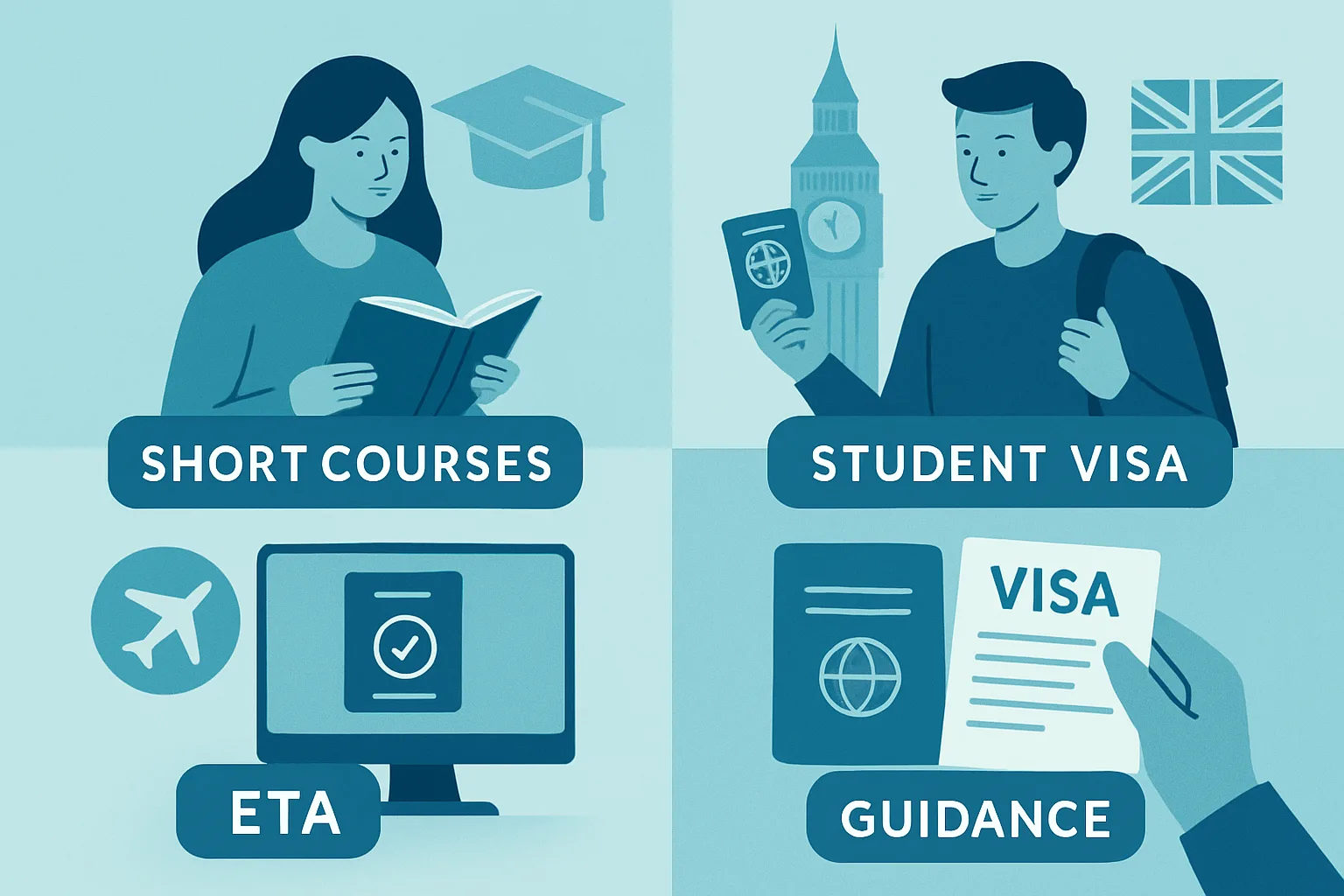
- UK ETA is for short-term study (e.g. language courses, summer schools) up to 6 months.
- Student Visa is for full-time degree courses longer than 6 months.
- Your nationality determines whether you can use an ETA or need a visa.
If you are planning to study in the UK, one of the first questions you will face is whether you need a UK ETA (Electronic Travel Authorisation) or a full Student Visa. The answer depends on the length and type of your course, your nationality, and your travel history. This guide will help you understand the key differences and choose the right permission for your studies.
The UK ETA is a digital travel authorisation for short stays, including tourism, business, and short-term study. It is not a visa but a pre-travel check for non-visa nationals. The Student Visa (formerly Tier 4) is for longer, formal academic programmes. Getting this wrong can mean being refused entry at the border, so it is vital to check the rules carefully.
This article covers everything you need to know: eligibility, application steps, fees, and what to do if your plans change. Always verify your specific situation with official sources before you travel, as rules can change.
What is a UK ETA and Who Can Use It for Study?
The UK ETA is an electronic travel authorisation introduced in 2023 for travellers who do not need a visa to visit the UK. It allows stays of up to 6 months for tourism, business, and certain permitted activities, including short-term study. It is linked to your biometric passport and is valid for multiple entries over two years (or until your passport expires). The system is designed to enhance border security by pre-screening travellers before they depart for the UK. For students, this means that if you are from an eligible country and your course is short, you can avoid the more lengthy and expensive visa process. The ETA is not a visa but a permission to travel; the final decision on entry is made by a Border Force officer upon arrival.
You can use a UK ETA for study if:
- You are a non-visa national (e.g., from the US, Canada, Australia, Japan, South Korea, etc.).
- Your course lasts no more than 6 months.
- You do not intend to work or extend your stay beyond 6 months.
- You are not enrolling in a full-time degree programme.
Examples of eligible courses include short language courses, summer schools, exchange programmes (up to 6 months), and short professional courses. For instance, a student from Canada attending a 4-week intensive English course in London, or a student from Japan participating in a 10-week summer programme at a UK university, could both use an ETA. Similarly, a professional from Australia taking a 3-month leadership course would qualify. You cannot use an ETA for a full undergraduate or postgraduate degree, such as a 3-year bachelor's programme or a 1-year master's course, as these exceed the 6-month limit.
What is a UK Student Visa and When Do You Need It?
The UK Student Visa is for individuals who want to study a full-time course at a recognised institution. It is required for courses longer than 6 months, such as bachelor's or master's degrees, or for courses below degree level that last more than 11 months. It also allows limited work rights (up to 20 hours per week during term time). This visa is part of the UK's points-based immigration system, and you must score enough points by meeting specific requirements, including having a Confirmation of Acceptance for Studies (CAS) from a licensed sponsor, demonstrating English language proficiency, and showing you have enough money to support yourself. The visa is typically granted for the duration of your course plus a short period afterwards, usually up to 4 months for degree-level courses, to allow you to prepare for departure or apply for a Graduate Visa.
You need a Student Visa if:
- Your course lasts more than 6 months.
- You are a visa national (from a country that requires a visa for any UK visit).
- You want to work while studying (beyond the very limited permission under a visitor visa).
- You plan to extend your stay for further study or work after your course.
The Student Visa requires a Confirmation of Acceptance for Studies (CAS) from your institution, proof of English language ability, and evidence of sufficient funds. Processing takes about 3 weeks outside the UK. For example, a student from India enrolling in a 3-year bachelor's degree in engineering would need a Student Visa, as would a student from Nigeria pursuing a 1-year master's in business administration. Even if you are from a non-visa national country, if your course is longer than 6 months, you must switch to a Student Visa. For instance, a student from the US studying a 9-month postgraduate certificate would need a Student Visa, not an ETA.
Key Differences Between UK ETA and Student Visa for Students
| Feature | UK ETA | Student Visa |
|---|---|---|
| Maximum stay | 6 months per visit | Length of course + up to 4 months |
| Course length | Up to 6 months | More than 6 months |
| Work permitted | No (except permitted paid engagements) | Yes (limited hours) |
| Multiple entries | Yes, valid 2 years | Usually single entry (but can re-enter with valid visa) |
| Application cost | £20 | £490 (plus healthcare surcharge) |
| Processing time | Minutes to 72 hours | 3 weeks (standard) |
| Eligibility | Non-visa nationals only | All nationalities (visa nationals need visa) |
This table highlights the core distinctions. The cost difference is significant: an ETA costs only £20, while a Student Visa costs £490, plus the Immigration Health Surcharge (IHS) which is currently £776 per year for students. The processing time for an ETA is much faster, often instant, compared to the 3-week standard for a Student Visa. However, the Student Visa offers work rights and a longer stay, which is essential for degree-level studies. For example, a student on a 1-year master's programme would pay £490 for the visa plus £776 for the IHS, totalling £1,266, whereas a student on a 6-month language course would pay just £20 for an ETA.
Short Courses Eligible for UK ETA
Short courses that qualify under the UK ETA include:
- Language courses (e.g., English as a Foreign Language) up to 6 months.
- Summer schools or study abroad programmes of less than 6 months.
- Short professional development courses (e.g., a 4-week management course).
- Exchange programmes that do not lead to a UK degree and last under 6 months.
- Research sabbaticals or attachments (if not doing a full degree).
You must not intend to work (except in limited circumstances like a permitted paid engagement). You also cannot extend your stay or switch to a Student Visa from within the UK if you entered with an ETA. For example, a student from South Korea attending a 8-week summer school at the University of Oxford could use an ETA. Similarly, a professional from Brazil taking a 12-week online marketing course in London would qualify. However, if that same professional later decided to enrol in a 1-year master's programme, they would need to leave the UK and apply for a Student Visa from their home country.
When a Student Visa is Mandatory
You must apply for a Student Visa if:
- Your course is longer than 6 months (e.g., a 3-year bachelor’s degree).
- You are a visa national (check the UK government’s list of countries whose citizens need a visa for any visit).
- You want to work while studying (even part-time).
- You plan to stay after your course to work (e.g., on a Graduate Visa).
If you enter on an ETA but later decide to enrol in a longer course, you must leave the UK and apply for a Student Visa from your home country. You cannot switch in the UK. For instance, a student from Japan who initially came on an ETA for a 3-month language course but then got accepted into a 1-year foundation programme would need to return to Japan, apply for a Student Visa, and wait for approval before starting the new course. This is a critical point: attempting to switch within the UK could lead to a refusal and potential difficulties with future applications.
Can I Use a UK ETA for a Short Course and Then Extend It?
No. The UK ETA does not allow extensions. You can stay for a maximum of 6 months per visit. If your course is longer than 6 months, you need a Student Visa. If your course is exactly 6 months, you can use an ETA but you cannot extend it. If you want to take another short course immediately after, you would need to leave and re-enter (but the total stay in any 12-month period should not exceed 6 months). The UK immigration rules are strict on this point to prevent individuals from using the ETA as a de facto long-term stay. For example, if you complete a 5-month language course and then want to start a 2-month professional course, you would need to leave the UK for a period (e.g., travel to France for a week) and then re-enter. However, if the total time you spend in the UK within a 12-month period exceeds 6 months, you may be questioned at the border about your intentions and could be refused entry.
For more details on extending your stay, see our guide on UK ETA renewal and extension — but note that extension is not possible for most visitors.
Application Process for UK ETA as a Student
Applying for a UK ETA is straightforward and fully online. Here are the steps:
- Check your nationality: You must be a non-visa national with a biometric passport from an eligible country.
- Prepare your documents: You need a valid biometric passport, an email address, and a debit/credit card for the £20 fee.
- Complete the online application: Provide personal details, passport information, and answer questions about your travel history and intentions.
- Pay the fee and submit: Most applications are approved within minutes to 72 hours.
- Receive your ETA via email: It is electronically linked to your passport.
For a full list of requirements, see our UK ETA application requirements page. It is important to apply well in advance of your travel, even though processing is fast. Some applications may require additional checks, especially if you have a complex travel history or if your name matches a watchlist. For example, a student from Australia with a common name might experience a delay of a few days. Always ensure the details you provide match your passport exactly, as any discrepancy could lead to a refusal.
Multiple Entry Rules for Students Using UK ETA
The UK ETA is valid for multiple entries over two years (or until your passport expires). This means you can leave and re-enter the UK multiple times during that period, as long as each stay does not exceed 6 months. This is useful for students on short courses who may want to travel home or to other countries during breaks. For instance, a student from Canada on a 5-month summer school could travel to France for a weekend and return to the UK without needing a new ETA. However, you cannot use the ETA to live in the UK by making frequent short trips. Border officers may question you if you spend more than 6 months in any 12-month period. For example, if you make three 2-month trips within a year, the total of 6 months might be acceptable, but if you make six 1-month trips, you might be seen as attempting to reside in the UK. For more details, see our guide on UK ETA multiple entry rules.
Dual Nationality and UK ETA for Students
If you hold dual nationality, you must use the passport that you used to apply for the ETA when travelling. If one of your nationalities is a visa national (e.g., Indian), you cannot use the ETA from your other nationality if you also hold that passport. You must apply for a visa using the passport that requires a visa. The UK government considers all your nationalities, and you must apply for a visa if any of them is a visa national. For example, if you are a US-Indian dual national, you cannot use a US passport to get an ETA and then travel on that passport to avoid the visa requirement. You would need to apply for a Student Visa using your Indian passport. This rule is strictly enforced to prevent visa shopping. For more, see our guide on UK ETA for dual nationals.
What Happens at the UK Border for ETA Holders?
When you arrive in the UK with an ETA, you will go through the ePassport gates (if eligible) or see a Border Force officer. You may be asked about the purpose of your visit, including your study plans. Be ready to show evidence of your course enrolment (e.g., acceptance letter, course details), accommodation, and return ticket. If you cannot satisfy the officer that you will leave at the end of your stay, you may be refused entry. Common questions include: “What course are you taking?”, “How long will you stay?”, “Do you have enough money?”, “Will you work?”. Answer honestly and clearly. For example, a student from South Korea attending a 6-week language course should have a letter from the language school, proof of accommodation (e.g., a hotel booking or rental agreement), and a return flight ticket. If the officer suspects the student might overstay or work illegally, entry could be denied. It is also advisable to carry proof of sufficient funds, such as bank statements, to cover your stay.
Can I Switch from ETA to Student Visa While in the UK?
Generally, no. If you enter the UK with an ETA, you are considered a visitor. You cannot apply to switch to a Student Visa from inside the UK unless you are applying under specific circumstances (e.g., you are a long-term resident of the UK). In most cases, you must leave the UK and apply for a Student Visa from your home country. This rule is designed to prevent individuals from circumventing the visa process by entering as a visitor and then changing their status. For example, a student from Brazil who came on an ETA for a 3-month course and then got accepted into a 1-year master's programme would need to return to Brazil, apply for a Student Visa, and wait for approval. Attempting to switch within the UK could lead to a refusal and a negative immigration record.
Financial Considerations for Students: ETA vs Student Visa
When choosing between a UK ETA and a Student Visa, financial factors play a significant role. The ETA costs only £20, making it highly affordable for short-term study. In contrast, a Student Visa costs £490, plus the Immigration Health Surcharge (IHS) of £776 per year, which grants access to the UK's National Health Service (NHS). For a 1-year course, the total would be £1,266; for a 3-year course, it would be £2,818. Additionally, Student Visa applicants must prove they have sufficient funds to cover tuition fees and living expenses (e.g., £1,334 per month for courses in London, or £1,023 per month outside London, for up to 9 months). For an ETA, you do not need to prove funds upfront, but you should have enough to support yourself during your stay. For example, a student from Japan on a 6-month language course might need to show around £6,000 to £8,000 in bank statements if asked at the border, whereas a Student Visa applicant for a 1-year master's in London would need to show at least £12,006 in living costs plus tuition fees. Always check the latest financial requirements on the official UK government website.
Health Insurance and Medical Care for ETA and Student Visa Holders
Health coverage differs significantly between the two permissions. With a UK ETA, you are a visitor and are not entitled to free NHS healthcare, except for emergency treatment in A&E. You should have comprehensive travel health insurance to cover any medical expenses, including doctor visits, hospital stays, and repatriation. For example, a student from Australia on a 4-week course should purchase insurance that covers illness or injury. In contrast, Student Visa holders pay the Immigration Health Surcharge (IHS) as part of their application, which grants them access to NHS services on the same basis as a UK resident. This includes visits to a GP, hospital treatment, and prescriptions (though prescription charges may apply in England). For a 1-year course, the IHS is £776, which is often cheaper than private insurance for the same period. For instance, a student from Canada on a 3-year bachelor's degree would pay £2,328 in IHS but would have comprehensive NHS coverage, whereas a student on a 6-month ETA would need to pay for private insurance, which might cost around £200-£500 for the duration.
Frequently Asked Questions
Can I work on a UK ETA as a student?
No. The UK ETA does not permit work, except for limited permitted paid engagements (e.g., giving a lecture). If you want to work part-time while studying, you need a Student Visa. For example, a student from the US on a 6-month language course cannot take a part-time job in a café, but a Student Visa holder can work up to 20 hours per week during term time.
How long does it take to get a UK ETA for study?
Most UK ETA applications are processed within minutes to 72 hours. However, some may take longer if additional checks are needed. Apply at least a few days before travel. For instance, if you are travelling next week, apply now to avoid delays.
What if my short course is extended beyond 6 months?
If your course extends beyond 6 months, you cannot stay on an ETA. You must leave the UK and apply for a Student Visa from your home country before continuing your studies. For example, if a 5-month course is extended to 7 months, you must exit the UK and apply for a Student Visa.
Do I need a UK ETA if I have a Student Visa?
No. If you hold a valid Student Visa, you do not need an ETA. The visa covers your stay for the duration of your course. For example, a student from India with a 2-year Student Visa does not need an ETA for travel during that period.
Can I use a UK ETA for a research sabbatical?
Yes, if the sabbatical is for less than 6 months and you are not enrolled in a degree programme. You must not work for a UK employer. For example, a professor from Australia taking a 3-month research sabbatical at a UK university could use an ETA, provided they are not paid by the UK institution.
Can I bring my family on an ETA while I study?
If you are on a UK ETA, your family members (e.g., spouse or children) can also apply for their own ETAs if they are non-visa nationals. However, they cannot work or study long-term. For example, a student from Japan on a 6-month language course could bring their spouse and child, who would each need their own ETA. In contrast, Student Visa holders can bring dependants only under specific conditions (e.g., for postgraduate courses at RQF level 7 or above).
What if my ETA application is refused?
If your UK ETA application is refused, you will be notified of the reason. Common reasons include providing incorrect information, having a criminal record, or being from a visa national country. You can reapply, but you should address the issue first. For example, if the refusal was due to a mismatch in your name, correct it and reapply. If you are a visa national, you must apply for a Student Visa instead. There is no formal appeal process for ETA refusals.
Key Takeaways
- Use a UK ETA for short courses up to 6 months if you are a non-visa national.
- Apply for a Student Visa for courses longer than 6 months, or if you are a visa national.
- You cannot work on an ETA, and you cannot extend it or switch to a Student Visa in the UK.
- Always check official government guidance before applying, as rules can change.
For the most up-to-date information, visit the UK government's official ETA guidance.
Frequently asked questions
Can I use a UK ETA for a short course and then switch to a Student Visa while in the UK?
What if my short course is extended beyond 6 months?
Can I work part-time on a UK ETA as a student?
Do I need a UK ETA if I already have a Student Visa?
Can I use a UK ETA for a research sabbatical or exchange programme?
This article is for general informational purposes only. Visa and travel authorisation rules change frequently. Always check the official government website before travelling.

Written & reviewed by
Can OTUTravel Authorisation Editor
Can OTU is the editor of ETA Travel Assistant, specialising in UK ETA, Schengen ETIAS, NZeTA and ESTA travel authorisations. Can monitors official government sources and policy updates to ensure every guide is accurate, current and genuinely useful for travellers.
View all guides →